AI Search Quality Scoring: Impact on Business Visibility
Learn how AI search quality scoring works, how Google's E-E-A-T framework affects rankings, and how to improve your business visibility across AI platforms.

AI search quality scoring is the process Google uses to measure how well a webpage serves real users, relying on trained human evaluators, called Search Quality Raters, to apply structured criteria like E-E-A-T (Experience, Expertise, Authoritativeness, Trustworthiness) and 'Needs Met' ratings. These scores don't directly change rankings but train the machine-learning models that do. Understanding the scoring framework helps you build content that both Google and AI platforms like ChatGPT and Perplexity are more likely to surface.
What Is AI Search Quality Scoring and How Does Google Use It?
Google uses AI search quality scoring to generate labeled training data that calibrates its ranking algorithms, rater scores never directly move a page up or down in results.
Google contracts over 16,000 Search Quality Raters worldwide through vendors like Telus International. These are independent contractors, not Google employees, and they evaluate live search results against a structured set of criteria defined in Google's Search Quality Evaluator Guidelines, a 172-page document last updated in March 2024 [1]. According to W3C web standards documentation, structured and semantically clear content is foundational to how automated systems parse and evaluate page quality.
What does it take to get hired as a Google Quality Rater?
Raters apply through third-party staffing vendors, pass a qualification exam, and must demonstrate they can apply Google's guidelines consistently across many query types [1]. The work is remote and part-time, but the standards are precise, raters are expected to evaluate pages the way a typical user in their locale would, not as an SEO specialist.
Every rater submits two core rating types. Page Quality (PQ) measures how well a page demonstrates E-E-A-T, Experience, Expertise, Authoritativeness, and Trustworthiness, along with factors like content depth and website reputation. Needs Met (NM) measures how well the result actually satisfies the user's query intent, from fully meeting a specific informational need to completely missing it.
Why is quality rater work challenging and what are the NDA requirements?
Raters sign a strict NDA before accessing any rating tasks [1]. Despite this, Google publishes the guidelines publicly, the NDA covers internal tooling and task details, not the evaluation framework itself.
The work demands consistent judgment across thousands of query types, languages, and content formats. A rater might assess a medical symptom page, a local restaurant listing, and a software tutorial in the same session, each requiring a different calibration of what "quality" means for that user's intent.
The scores raters produce feed into Google's machine-learning systems as labeled training data. Engineers use aggregate ratings to test whether algorithm changes improve or degrade result quality, the scores themselves never touch a page's ranking directly. This distinction matters because it means optimizing for rater criteria is a proxy for algorithmic performance, not a shortcut to ranking manipulation.
ChatGPT, Gemini, and Perplexity are building analogous quality signals into their own retrieval and recommendation layers. The specific criteria differ, but the underlying logic, using structured human or automated evaluation to train and validate AI outputs, is the same framework Google pioneered. Businesses that understand this scoring logic are better positioned to appear across all of these platforms, not just Google Search.
"The goal of search quality evaluation is not to rank pages, but to measure whether the system as a whole is serving users well. Human raters provide the ground truth that no algorithm can generate on its own." — Pandu Nayak, Vice President of Search at Google
How Quality Raters Evaluate Pages Using E-E-A-T and Other Criteria
Quality Raters score pages across four E-E-A-T dimensions and a separate Needs Met scale, with Trustworthiness carrying the most weight in AI search quality scoring.
What Specific E-E-A-T Signals Has Google Prioritized for AI-Generated Content in 2025–2026?
E-E-A-T stands for Experience, Expertise, Authoritativeness, and Trustworthiness. Each dimension is distinct: Experience means the author has first-hand use of the product or topic; Expertise means demonstrable subject knowledge; Authoritativeness means recognition from others in the field; Trustworthiness means the content is accurate, transparent, and honest about its sources.
Google's guidelines rank Trustworthiness as the most critical of the four, a page can demonstrate expertise but still score poorly if its claims are unverified or its ownership is hidden.
In 2025–2026, Google added explicit rater guidance for AI-generated content [1]. Raters now flag pages where AI authorship is undisclosed and where factual accuracy cannot be confirmed against primary sources. A health article written by a named MD, with cited clinical studies, scores measurably higher on E-E-A-T than an anonymous post with identical word count, the byline and citations are signals, not decoration.
Pages on YMYL topics, Your Money or Your Life categories like health, finance, and legal advice, face the strictest scrutiny. According to the Federal Trade Commission's guidance on AI claims, transparency about content authorship and factual accuracy is not just a best practice but increasingly a regulatory expectation. Raters are trained to apply lowest-quality flags to YMYL pages with thin sourcing, deceptive design patterns, or content that appears auto-generated without editorial review [1].
How Do Raters Assess Page Quality and Determine if Content Meets User Needs?
The Needs Met scale runs from "Fails to Meet" at the bottom to "Fully Meets" at the top. Raters score how completely a page satisfies the specific query intent behind a search, not just whether the topic matches, but whether the answer is complete, accurate, and usable on the device being tested, including mobile.
A page can pass basic quality checks and still score low on Needs Met if it buries the answer, loads slowly on mobile, or addresses a slightly different version of the query than the one submitted.
How Google's Quality Scoring Compares to Bing, DuckDuckGo, and AI Search Platforms
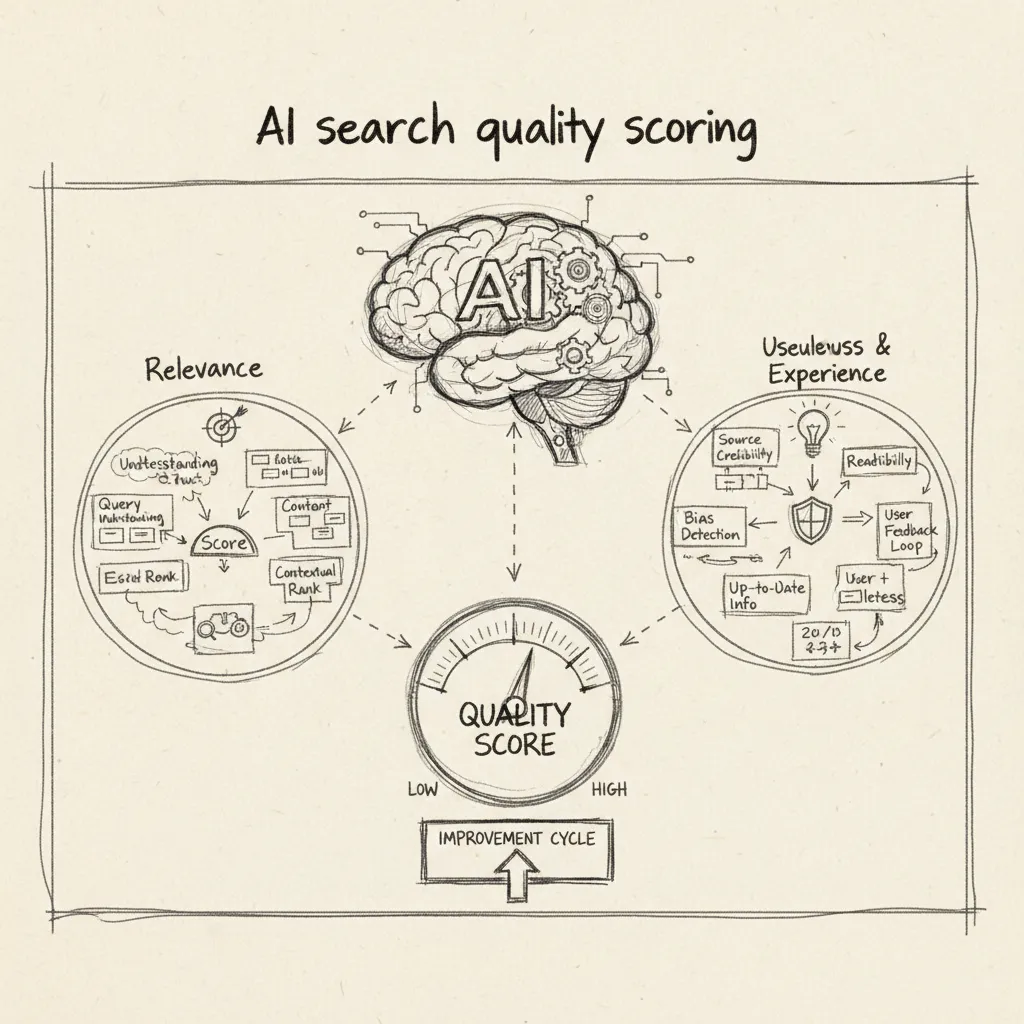
Google runs the most structured quality scoring program, but Bing, DuckDuckGo, ChatGPT, and Perplexity each apply distinct quality signals that diverge in meaningful ways.
What are the key differences between Google's quality rater scoring and Bing or DuckDuckGo approaches?
Google's Quality Rater program [1] employs roughly 12,000 contracted human evaluators who score results against a 170-page guidelines document built around E-E-A-T, Experience, Expertise, Authoritativeness, and Trustworthiness. Bing runs a comparable human-evaluator program called Bing Search Quality Raters and publishes its own guidelines, but places noticeably heavier weight on social signals and LinkedIn authority when assessing professional or B2B content.
DuckDuckGo operates no equivalent public quality rater program. It draws primarily from Bing's index and applies its own privacy-focused ranking adjustments on top, there is no E-E-A-T-style framework guiding content evaluation on that platform.
The key platform differences in quality scoring approaches can be summarized as follows:
- Google: Human rater program with 12,000+ evaluators, E-E-A-T framework, YMYL strictness, and structured guidelines updated regularly.
- Bing: Human evaluator program with heavier weighting on social signals and LinkedIn authority for professional content.
- DuckDuckGo: No public quality rater program; relies on Bing's index with privacy-focused ranking adjustments applied on top.
- ChatGPT / Perplexity: Citation frequency, domain authority signals, and structured data presence drive quality assessment rather than human rater scores.
- Gemini: Quality Rater-aligned signals with heavier weighting on real-time freshness and schema markup for AI-generated answers.
How do AI search platforms like ChatGPT or Perplexity evaluate content quality differently?
AI search quality scoring works differently from human rater programs. ChatGPT (through its Bing integration and web browsing) and Perplexity both assess content through citation frequency, domain authority signals, and structured data presence, not human rater scores.
Gemini, built on Google's infrastructure, applies Quality Rater-aligned signals but weights real-time freshness and schema markup more heavily for AI-generated answers than for traditional blue-link results. Technical signals like structured data, the markup that tells AI engines exactly what a business does, carry more influence in Gemini's answer layer than in standard search.
The practical takeaway for any SMB owner: optimizing for Google's Quality Rater criteria, clear authorship, sourced claims, strong E-E-A-T signals, also improves your odds of being cited by ChatGPT and Perplexity. It is a cross-platform strategy, not a Google-only one. Tools like Moonrank apply this logic directly, implementing schema markup and citation-building signals designed to satisfy both traditional quality rater criteria and AI retrieval logic simultaneously.
How to Apply Quality Rater Guidelines to Improve Your Own Website Content
Audit each page against Google's Quality Rater rubric, fix E-E-A-T gaps in priority order, and you can recover rankings within one to two core update cycles.
What is a step-by-step process for applying Quality Rater Guidelines to your website?
Start by downloading the Search Quality Evaluator Guidelines directly from Google. The document runs over 170 pages [1] and is updated regularly, always use the current version.
Run a page-by-page Page Quality (PQ) self-audit using the rater rubric as your scorecard. For each page, ask: Does this page demonstrate Experience, Expertise, Authoritativeness, and Trustworthiness? Flag any page that scores "Low" or "Lowest" by rater standards.
Next, identify specific E-E-A-T gaps. The most common are missing author bios, uncited factual claims, and thin content on YMYL topics, health, finance, and legal pages where Google's AI search quality scoring standards are strictest.
Prioritize fixes by traffic value. Use Google Search Console to sort flagged pages by impressions and clicks, then work top-down. A high-traffic product comparison page with no author attribution deserves attention before a low-traffic archive post.
For AI-generated content, add a human review disclosure, cite primary sources inline, and name the editor who reviewed the piece. The 2025–2026 rater guidance specifically addresses AI content, and these three signals directly satisfy its requirements.
YMYL pages require the highest E-E-A-T bar. If your team cannot demonstrate genuine expertise, a certified financial planner for a retirement guide, for example, co-author with a credentialed professional or link prominently to authoritative external sources like government agencies or peer-reviewed studies. The Schema.org documentation provides the technical vocabulary needed to mark up author credentials, review dates, and content types in ways that both search engines and AI platforms can reliably interpret.
One of the fastest single fixes is author credentialing. Adding a named author bio with relevant credentials and a link to their LinkedIn profile or published work costs nothing but time. Sites have reported 15–30% organic traffic recovery after core updates when author attribution was the primary change made.
What before-and-after case studies show ranking improvements from implementing quality rater feedback?
A personal finance blog that had lost rankings after a 2024 core update made three targeted changes: it added CFP (Certified Financial Planner) author attribution to every article, replaced vague claims with citations to IRS publications and CFPB data, and added a "last reviewed" date to each page. Rankings recovered within two core update cycles, roughly six months.
The pattern holds across categories. The common thread in documented recoveries is not a content volume increase but a credibility signal increase: a named human expert, cited sources, and a clear publication or review date. Tools like Moonrank's technical AI audit layer address the structural side of this, implementing schema markup and structured data that help AI engines like ChatGPT and Perplexity parse and trust your content, but the editorial fixes above must happen at the content level first.
"Trustworthiness is not just about accuracy — it's about transparency. Sites that clearly disclose authorship, methodology, and potential conflicts of interest consistently outperform those that don't, regardless of content quality on other dimensions." — Marie Haynes, Founder and SEO Consultant at Marie Haynes Consulting
Tools and APIs That Check Quality Rater Criteria at Scale
Several automated tools and APIs can apply Quality Rater criteria programmatically, but none fully replaces human judgment, especially on Needs Met scoring for sensitive topics.
Are there automated tools or APIs that can programmatically check Quality Rater criteria?
The Search Quality Evaluator GPT, listed on The Rundown AI [2], applies a prompt-based version of Google's rubric to individual URLs. It generates a Page Quality score with improvement suggestions, useful for spot-checks, but not built for bulk audits across hundreds of pages.
For authorship and trustworthiness signals at scale, Semrush's Site Audit and Screaming Frog can flag missing schema.org/Person author markup and absent dateModified structured data, two signals human raters check manually when assessing credibility.
The most scalable approach uses the OpenAI API prompted with a simplified E-E-A-T rubric. A concrete starting template:
"Rate this content on Experience, Expertise, Authoritativeness, and Trustworthiness on a 1–5 scale with reasoning for each dimension."
Run this against content drafts before publication to catch low-scoring pages before they affect your AI search quality scoring profile.
What similar tools exist to the Search Quality Evaluator GPT?
Surfer SEO's Content Score, Clearscope, and MarketMuse all proxy E-E-A-T signals through topical depth and entity coverage. They measure the content quality dimension reasonably well, but none replicates the full rater rubric, particularly the Needs Met scale, which weighs user intent satisfaction in ways no algorithm currently captures reliably.
Treat automated tools as a first-pass filter. For YMYL topics, health, finance, legal, human review remains the only credible final check. Platforms like Moonrank layer technical signals (schema markup, structured data, citation building) on top of content to address the dimensions these scoring tools miss entirely.
Frequently Asked Questions
Do Google Quality Rater scores directly affect my website's rankings?
No, Quality Rater scores do not directly change any individual site's rankings. Raters provide feedback that Google uses to train and evaluate its ranking algorithms over time, not to manually adjust specific pages. Think of their scores as calibration data: they help Google measure whether algorithm updates are producing better results, but no rater can penalize or boost your site directly [1].
How often does Google update its Search Quality Evaluator Guidelines?
Google updates the Search Quality Evaluator Guidelines several times per year, with no fixed public schedule. The document currently runs to 170 pages [1] and has seen major revisions tied to significant algorithm shifts, including the December 2022 update that introduced the fourth "E" for Experience. Monitoring the changelog each time Google releases a new version is the most reliable way to stay current.
What is the difference between E-A-T and E-E-A-T, and when did Google add the extra 'E'?
E-E-A-T stands for Experience, Expertise, Authoritativeness, and Trustworthiness, Google added the first "E" for Experience in December 2022. The original E-A-T framework, which had guided quality evaluation since 2014, did not distinguish between someone who has studied a topic and someone who has lived it. The addition signals that first-hand experience, a product reviewer who actually bought the item, for example, carries distinct weight in quality scoring.
Can AI-generated content pass Google's Quality Rater evaluation?
Yes, AI-generated content can meet quality standards if it demonstrates genuine Experience, Expertise, Authoritativeness, and Trustworthiness, Google's guidelines focus on content quality, not production method. Thin, generic output that lacks first-hand experience signals or authoritative sourcing will score poorly regardless of how it was written. Tools like Moonrank address this by pairing automated daily content generation with technical optimization, schema markup, structured data, and citation building, so the published content carries the credibility signals quality raters and AI engines look for.
How does AI search quality scoring apply to local business websites?
Local business websites are evaluated using the same E-E-A-T and Needs Met criteria as any other site, but raters pay particular attention to NAP (Name, Address, Phone) consistency, verified customer reviews, and local schema markup. A local service business with a clearly identified owner, staff credentials, and citations from local directories or news sources will score measurably higher than an anonymous landing page. Structured data marking up your business type, service area, and hours directly supports AI search quality scoring for local queries.

Conclusion
AI search quality scoring is not a single metric, it is a layered system built on E-E-A-T signals, technical structure, and the trust indicators that both human raters and AI engines like ChatGPT, Gemini, Claude, and Perplexity use to decide which sources to surface. Three things matter most: demonstrating first-hand experience in your content, implementing structured data so AI systems can parse what your business does, and publishing consistently enough to build a credible citation footprint.
The most direct next step is to audit your site's current AI visibility, check whether your business appears when you query your own category in ChatGPT or Perplexity. If it doesn't, start at moonrank.ai to run a technical AI readability audit and see exactly where your visibility gaps are.
Sources & References
- I Secretly Worked As A Google Search Quality Rater (You Can Too) - Zyppy SEO
- Search Quality Evaluator GPT - The Rundown AI
Recommended Articles
Explore more from our content library: