AI Search Engine Optimization: Complete 2026 Guide
Learn AI search engine optimization strategies for 2026. Get discovered by ChatGPT, Gemini, Claude & Perplexity with proven AEO techniques. Discover essential.
Key Insight | Explanation |
|---|---|
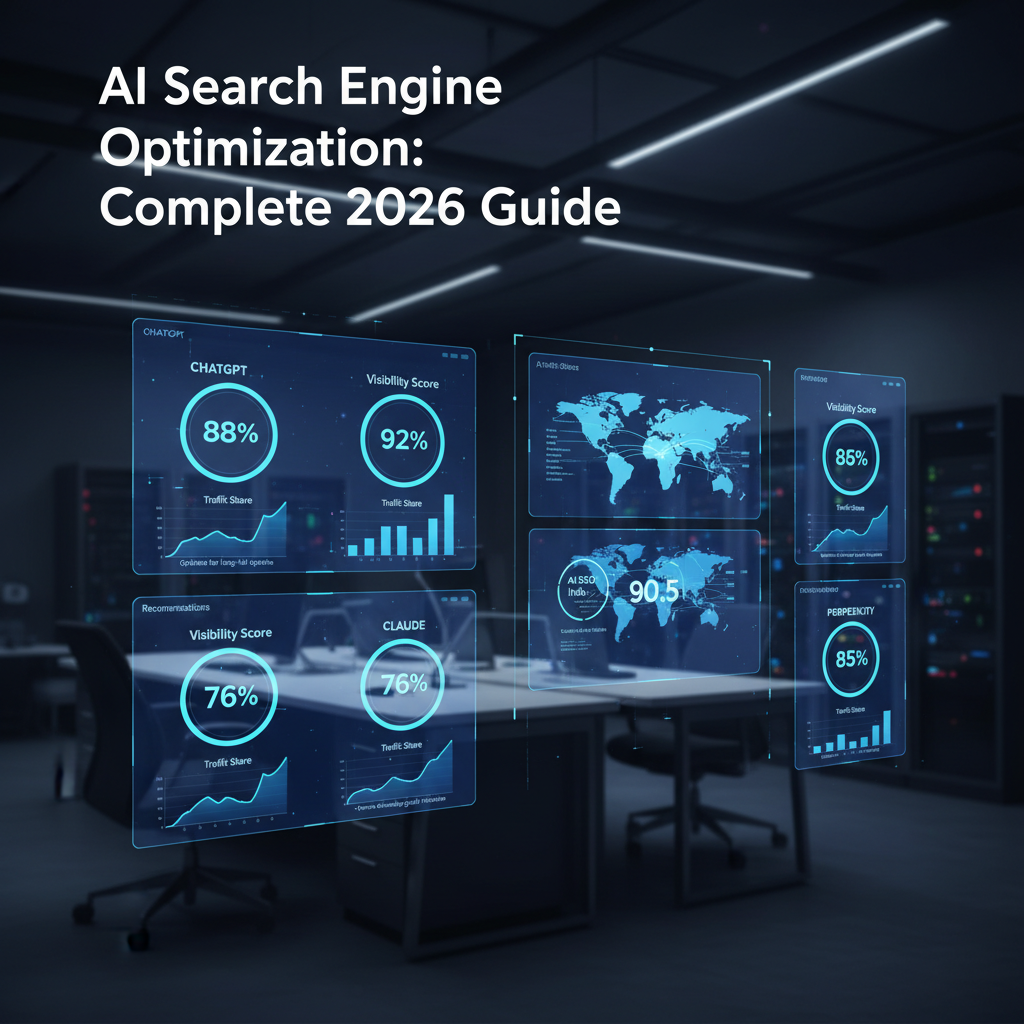
AI Search Engines Process Content Differently | Understanding AI search engine optimization is essential. Unlike traditional search engines, AI systems like ChatGPT and Perplexity prioritize context, intent, and structured information over keyword density |
Answer-First Content Structure | AI engines extract direct answers from content, making question-answer formatting and clear headings essential for visibility |
Entity Recognition Drives Rankings | AI systems understand and cross-reference specific entities (brands, people, locations) to determine content authority and relevance |
Technical Optimization Requirements | Schema markup, structured data, and proper citation formatting help AI engines understand and recommend your content |
Multi-Engine Strategy Needed | Each AI search engine (ChatGPT, Claude, Gemini, Perplexity) has unique preferences requiring tailored optimization approaches |
Automated Solutions Emerging | Platforms now offer automated daily content generation and technical optimization specifically for AI search visibility |
Table of Contents
The digital landscape has fundamentally shifted as artificial intelligence transforms how people discover information online. AI search engine optimization represents a new frontier in digital marketing, where businesses must adapt their content strategies to get recommended by ChatGPT, Gemini, Claude, and Perplexity instead of just ranking on Google. AI search engine optimization is the practice of optimizing your online presence and content so that AI-powered search engines and chatbots recommend your business when users ask relevant questions. Unlike traditional SEO that focuses on keyword rankings, AI search optimization prioritizes context, intent, and structured information that artificial intelligence systems can easily interpret and cite [1].
This comprehensive guide will walk you through everything you need to know about AI search engine optimization in 2026, from understanding how these systems work to implementing proven strategies that get your business discovered by AI search engines.
What Is AI Search Engine Optimization?
AI search engine optimization (also known as AEO or GEO - Generative Engine Optimization) is the strategic process of optimizing content and technical elements to increase visibility in AI-powered search results and conversational AI responses. This emerging field represents a fundamental shift from traditional search engine optimization toward optimizing for how artificial intelligence systems understand, process, and recommend content [2].
Core Differences from Traditional SEO
Traditional SEO focuses on ranking web pages for specific keywords in search engine results pages (SERPs). AI search optimization, however, centers on getting your content cited, referenced, or recommended when AI systems generate responses to user queries. The key distinction lies in how these systems process information:
Traditional search engines crawl and index web pages, then rank them based on relevance signals
AI search engines analyze content for context, extract key information, and synthesize responses from multiple sources
User behavior shifts from clicking through search results to receiving direct answers from AI systems
Content must be structured for machine interpretation rather than just human readability
The AI Search Ecosystem in 2026
As of 2026, several major AI search platforms dominate the landscape. Each system has unique characteristics that affect optimization strategies:
AI Search Engine | Key Features | Optimization Focus |
|---|---|---|
ChatGPT | Conversational responses, web browsing capability | Natural language, question-answer format |
Perplexity | Real-time search with citations | Authoritative sources, proper citations |
Claude | Analytical reasoning, document analysis | Structured data, logical content flow |
Gemini | Multimodal understanding, Google integration | Rich media content, entity recognition |
Pro Tip: Focus on one AI search engine initially to understand its preferences, then expand your optimization strategy to cover multiple platforms systematically.
The rise of AI search represents more than a technological shift. Research from Harvard indicates that traditional search engine optimization principles must evolve to accommodate how artificial intelligence systems interpret and synthesize information [4]. Businesses that adapt early to these changes position themselves for sustained visibility as user behavior continues migrating toward AI-powered discovery methods.
How AI Search Optimization Works
AI search optimization operates on fundamentally different principles than traditional SEO, requiring businesses to understand how artificial intelligence systems process, analyze, and synthesize information from across the web.
Content Processing and Understanding
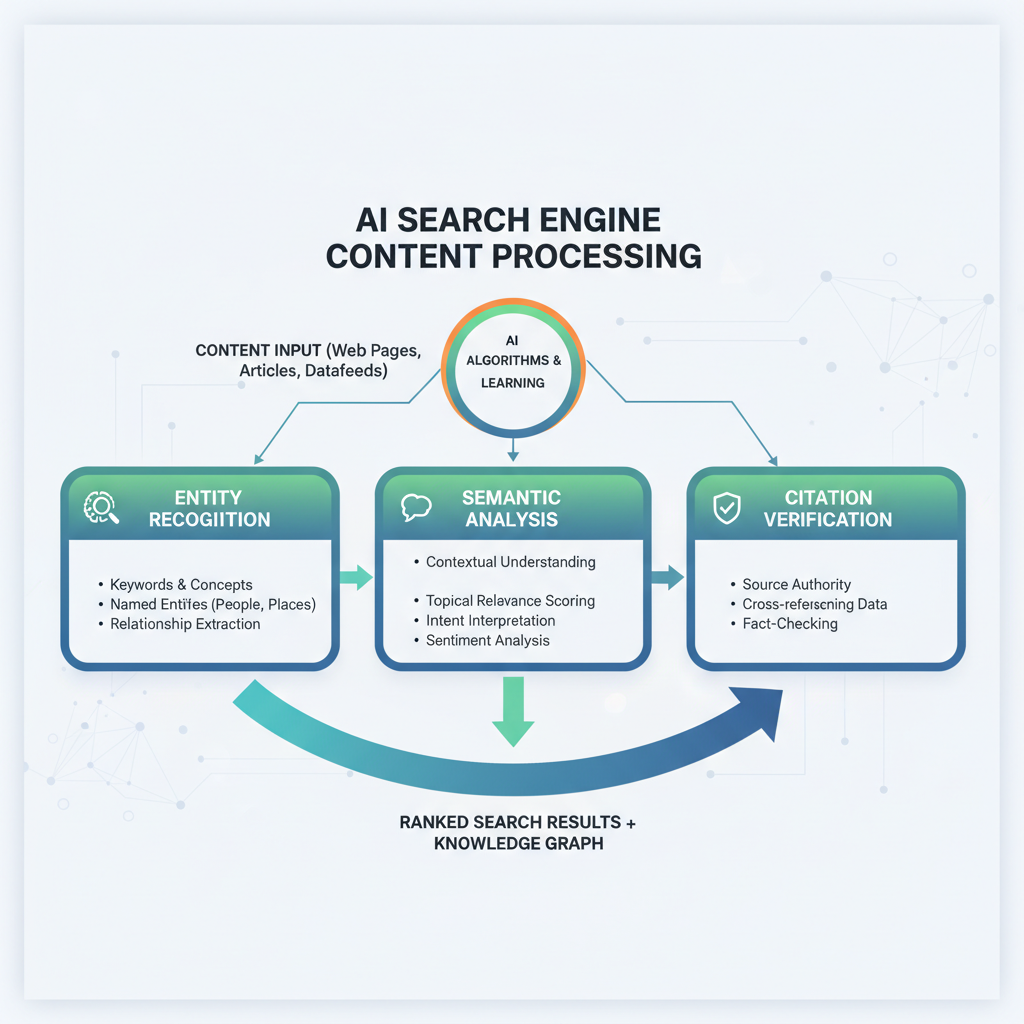
AI search engines don't simply match keywords to queries. Instead, they analyze content for semantic meaning, context, and relationships between concepts. When a user asks a question, these systems:
Parse the query to understand intent and context
Search through their knowledge base and real-time web data
Identify relevant sources that address the query comprehensively
Extract key information and synthesize a coherent response
Cite or reference sources that provided the most valuable information
This process means your content needs to be structured for machine interpretation. AI systems excel at recognizing patterns, extracting facts, and understanding relationships between entities. Content that clearly states facts, provides direct answers, and uses logical organization performs better in AI search results [3].
Entity Recognition and Authority
Modern AI search engines rely heavily on entity recognition to determine content authority and relevance. Entities include specific people, places, organizations, products, or concepts that the AI can verify and cross-reference. When your content mentions recognizable entities and establishes clear relationships between them, AI systems gain confidence in recommending your information. For example, if you're writing about digital marketing trends, mentioning established frameworks like "AIDA methodology" or referencing authoritative organizations helps AI systems understand your content's credibility and context.
Technical Infrastructure Requirements
AI search optimization requires specific technical elements that help artificial intelligence systems understand and process your content effectively:
Schema markup: Structured data that explicitly defines content elements and relationships
Citation formatting: Proper attribution and linking to authoritative sources
Semantic HTML: Clean, logical markup that clearly defines content hierarchy
robots.txt optimization: Ensuring AI crawlers can access your content appropriately
Pro Tip: Many businesses unknowingly block AI search engines by restricting CCBot (Common Crawl) in their robots.txt file, which prevents AI systems from accessing their content for training and responses.
Research from ArXiv demonstrates that AI search engines prioritize content that provides direct answers to questions, uses clear headings to organize information, and includes proper citations to authoritative sources [5]. This represents a significant departure from traditional SEO tactics focused primarily on keyword density and backlink profiles. The technical foundation of AI search optimization also includes ensuring your content is accessible to AI crawlers. Unlike traditional search engine bots that primarily index text content, AI systems may analyze multiple content formats and require different access patterns to understand your information comprehensively.
Key Benefits of AI Search Engine Optimization in 2026
AI search engine optimization offers distinct advantages that extend beyond traditional search visibility, fundamentally changing how businesses connect with their target audiences in an AI-driven discovery environment.
Enhanced Discovery and Recommendation
The primary benefit of AI search optimization lies in getting your business recommended rather than simply ranked. When someone asks ChatGPT "What's the best project management software for small teams?" or queries Perplexity about "affordable marketing automation tools," proper AI optimization ensures your business appears in those conversational responses. This shift represents a fundamental change in user behavior. According to Salesforce's 2026 research, over 60% of professionals now use AI search engines for business research before making purchasing decisions [6]. Unlike traditional search where users browse through multiple results, AI search provides direct recommendations, making visibility in these responses crucial for business growth.
Competitive Advantage in Emerging Channels
Most businesses haven't yet adapted their digital strategies for AI search engines, creating significant opportunities for early adopters. While competitors focus solely on Google rankings, businesses optimizing for AI search gain access to entirely new discovery channels with less competition. The benefits extend across multiple touchpoints:
Direct business recommendations in AI responses to relevant queries
Increased brand authority through citations in AI-generated content
Access to users who prefer conversational search over traditional browsing
Higher conversion rates from qualified traffic seeking specific solutions
Cost-Effective Marketing Channel
Traditional SEO agencies typically charge $3,000-$10,000 monthly for comprehensive optimization services. AI search optimization, however, can be implemented through automated platforms at a fraction of this cost. Modern solutions provide daily content generation, technical optimization, and visibility tracking across multiple AI search engines for under $100 monthly.
Marketing Channel | Monthly Cost Range | Setup Complexity | Time to Results |
|---|---|---|---|
Traditional SEO Agency | $3,000 - $10,000 | High | 3-6 months |
Paid Advertising | $2,000 - $15,000 | Medium | Immediate |
AI Search Optimization | $99 - $500 | Low | 2-4 weeks |
Content Marketing | $1,500 - $5,000 | Medium | 1-3 months |
Measurable Impact on Business Growth
AI search optimization provides trackable results across multiple metrics that directly correlate with business growth. Unlike traditional brand awareness campaigns, AI search visibility can be measured through specific mentions, recommendations, and citation frequency across different AI platforms. Businesses implementing comprehensive AI search strategies report significant improvements in qualified lead generation. The conversational nature of AI search means users asking specific questions are often further along in their buying journey, resulting in higher conversion rates compared to traditional search traffic.
Pro Tip: Track your AI search visibility across multiple platforms simultaneously. What works for ChatGPT may not work for Perplexity, and each platform requires tailored optimization approaches.
The long-term benefits compound as AI systems learn and improve their understanding of your business. Consistent optimization builds authority within AI knowledge bases, creating sustainable competitive advantages that become increasingly difficult for competitors to overcome.
Common Challenges and Mistakes
Businesses entering AI search optimization face several critical pitfalls that can undermine their efforts and waste valuable resources. Understanding these challenges helps avoid costly mistakes and accelerates success in AI search visibility.
Applying Traditional SEO Tactics
The most common mistake involves directly applying traditional SEO strategies to AI search optimization. Many businesses continue focusing on keyword density, backlink building, and meta tag optimization while ignoring the fundamental differences in how AI systems process content. AI search engines prioritize context and semantic meaning over keyword matching. Content stuffed with keywords but lacking clear structure or direct answers performs poorly in AI search results. Similarly, traditional link-building campaigns don't translate directly to AI search authority, which relies more on content quality and entity recognition. Common tactical mistakes include:
Optimizing for keyword density instead of semantic relevance
Creating content that ranks well on Google but doesn't answer questions directly
Ignoring structured data and schema markup essential for AI understanding
Focusing solely on text content while neglecting multimedia optimization
Technical Implementation Errors
Many businesses inadvertently block AI search engines from accessing their content through improper technical configurations. Research from Common Crawl indicates that numerous websites restrict CCBot in their robots.txt files, preventing AI systems from crawling and understanding their content [7]. Critical technical mistakes include:
Blocking AI crawlers through restrictive robots.txt configurations
Implementing schema markup incorrectly, confusing AI interpretation
Using unclear heading structures that don't support AI content extraction
Failing to optimize page loading speeds for AI crawler efficiency
Neglecting mobile optimization essential for AI content analysis
Content Structure and Format Issues
AI search engines excel at extracting specific information from well-structured content. However, many businesses create content that's difficult for AI systems to parse and understand. This includes walls of text without clear headings, indirect answers to common questions, and poor use of formatting elements that help AI systems identify key information.
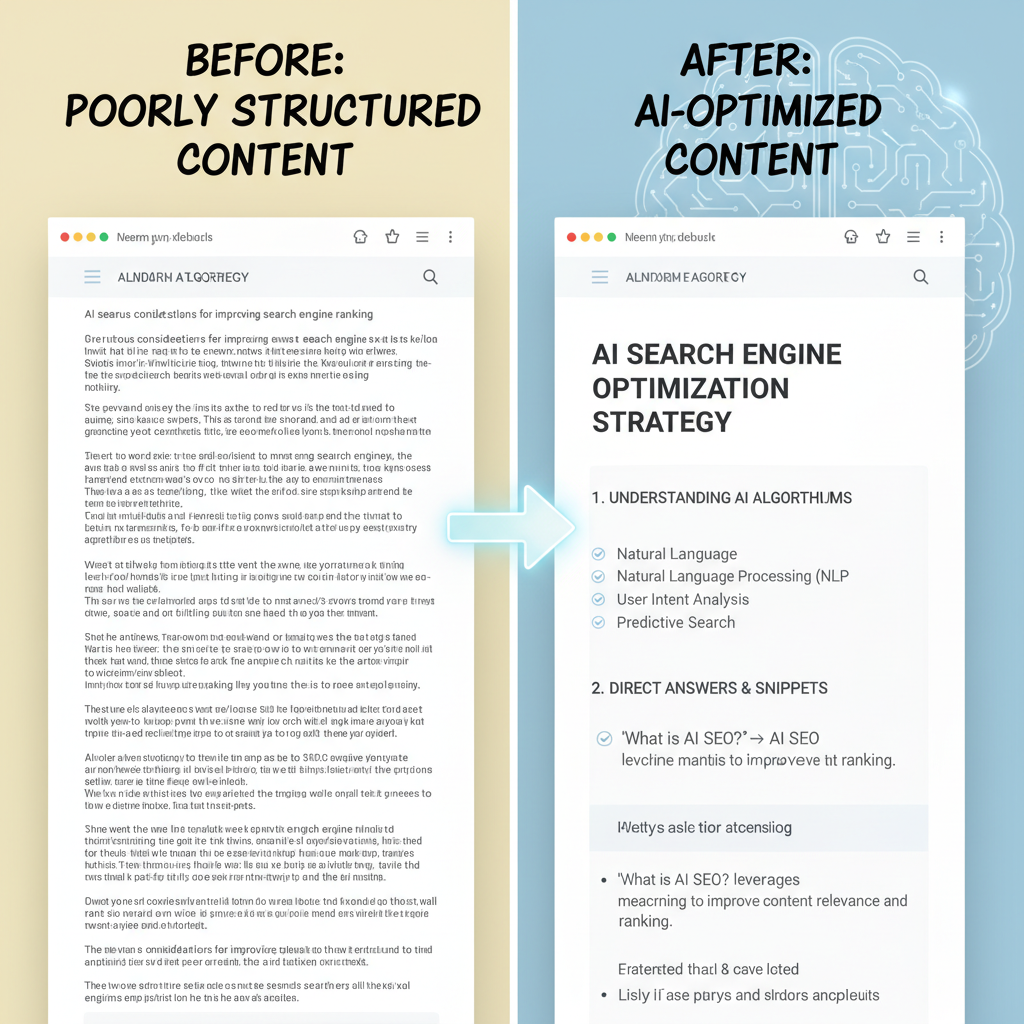
Pro Tip: Start each content section with a direct answer to the implied question. AI systems often extract these opening sentences for responses, making clarity crucial for visibility.
Platform-Specific Optimization Oversights
Each AI search engine has unique preferences and requirements. Businesses often make the mistake of treating all AI platforms identically, missing optimization opportunities specific to individual systems. ChatGPT responds well to conversational content, while Perplexity prioritizes authoritative citations, and Claude favors logical, structured information. The challenge compounds when businesses attempt to optimize for all platforms simultaneously without understanding their distinct characteristics. This approach often results in generic content that doesn't excel on any particular platform rather than targeted optimization that maximizes visibility across specific AI search engines. Successful AI search optimization requires acknowledging these platforms' differences and developing tailored strategies that account for each system's unique content preferences and technical requirements. Businesses that recognize and address these challenges early position themselves for sustained success in the evolving AI search landscape.
Best Practices for AI Search Engine Optimization in 2026
Implementing effective AI search engine optimization requires a strategic approach that addresses both technical requirements and content optimization across multiple AI platforms. These proven practices help businesses maximize their visibility in AI search results.
Content Structure and Formatting
AI search engines excel at extracting information from well-structured content that follows predictable patterns. The most effective approach involves organizing content with clear hierarchies and direct answers to common questions. Start each section with a standalone answer that AI systems can extract independently. This means the first sentence after each heading should provide a complete, factual response that makes sense without surrounding context. AI engines often pull these opening statements for their responses, making clarity and completeness essential. Effective content structure includes:
Clear H2 and H3 headings that pose questions or state topics directly
Opening sentences that provide complete, extractable answers
Bullet points and numbered lists for complex information
Tables for comparisons, specifications, or structured data
Short paragraphs (2-3 sentences) that focus on single concepts
Technical Optimization Requirements
Technical optimization for AI search differs significantly from traditional SEO requirements. AI systems need specific signals to understand, process, and cite your content effectively. Schema markup becomes critical for AI search optimization. Unlike traditional SEO where schema provides minor ranking benefits, AI systems rely heavily on structured data to understand content relationships and context. Implement schema markup for articles, businesses, products, and frequently asked questions to help AI engines categorize and extract your information accurately. Essential technical elements include:
Comprehensive schema markup covering all content types
Clean HTML structure with semantic tags (article, section, aside)
Proper robots.txt configuration allowing AI crawler access
Fast loading speeds optimized for AI crawler efficiency
Mobile-responsive design ensuring accessibility across devices
Pro Tip: Create an llms.txt file in your website root directory to provide specific instructions for AI systems about how to understand and cite your content. This emerging standard helps AI engines process your information more effectively.
Multi-Platform Optimization Strategy
Different AI search engines have distinct preferences that require tailored optimization approaches. Rather than attempting to optimize for all platforms simultaneously, focus on understanding each system's unique characteristics and developing targeted strategies.
AI Platform | Content Preference | Key Optimization Focus |
|---|---|---|
ChatGPT | Conversational, natural language | Question-answer format, clear explanations |
Perplexity | Authoritative sources with citations | Credible references, fact-based content |
Claude | Analytical, structured information | Logical flow, detailed analysis |
Gemini | Multimodal content integration | Rich media, entity relationships |
Automated Implementation and Monitoring
Manual AI search optimization quickly becomes overwhelming given the volume of content required and the technical complexity involved. Successful businesses in 2026 leverage automated platforms that handle daily content generation, technical optimization, and visibility tracking across multiple AI search engines. Automation benefits include consistent content publishing, technical maintenance, and performance monitoring without requiring dedicated internal resources. At Moonrank, we've found that businesses using automated AI search optimization see measurable improvements in AI visibility within 2-4 weeks, compared to 3-6 months for manual implementation approaches.
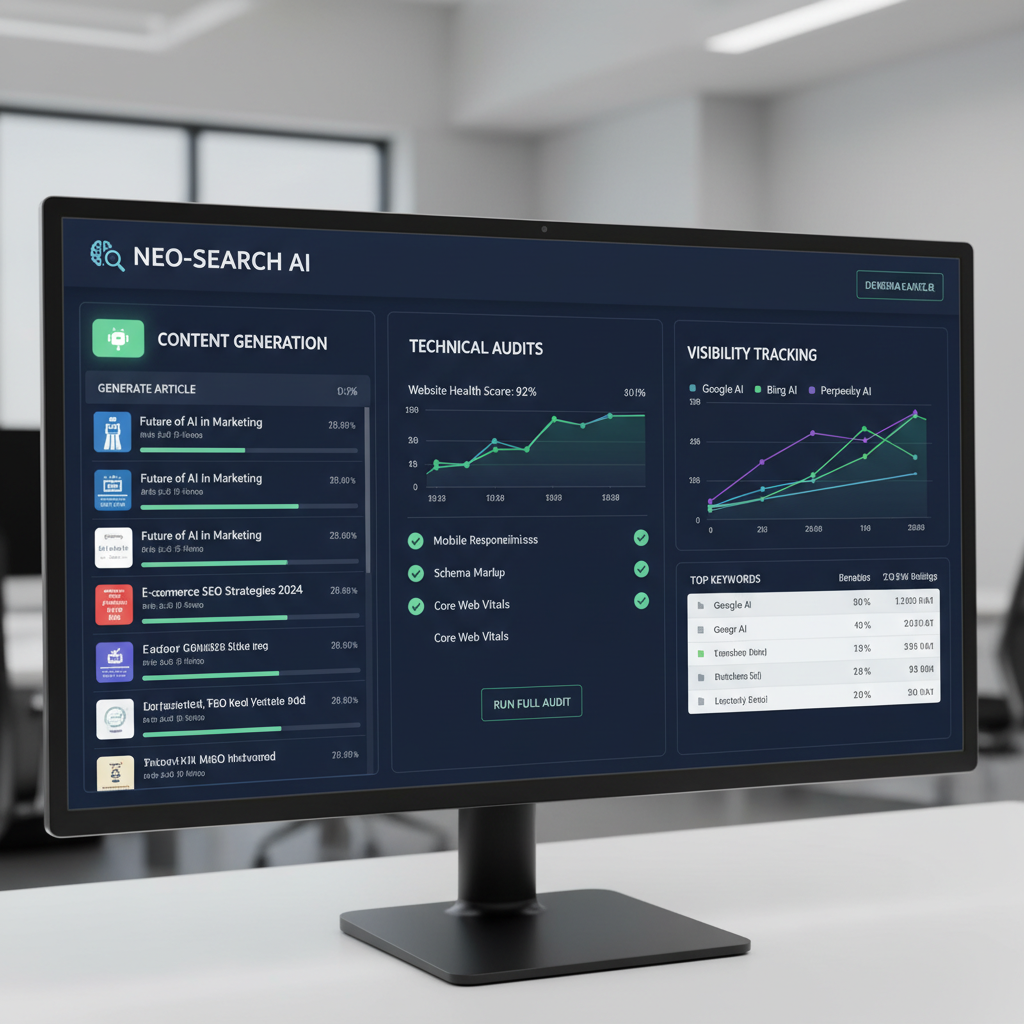
The key lies in selecting platforms that understand the nuances of different AI search engines rather than applying generic optimization approaches. Effective automation should handle content creation, technical optimization, citation management, and performance tracking while allowing customization for specific business needs and industry requirements.
Sources & References
Google Developers, "Top ways to ensure your content performs well in Google's AI", 2025
Research FDI, "The Future of SEO: How AI Is Already Changing Search Engine", 2026
Marketing Aid, "AI Search Optimization: SEO for Perplexity, ChatGPT and more", 2026
Harvard Sites, "Optimizing your site for search engines and artificial intelligence", 2026
ArXiv, "Generative Engine Optimization: How to Dominate AI Search", 2024
Common Crawl, "AI Optimization Is Here: Are You Ready for Search 2.0?", 2026
Semrush, "How to Optimize for AI Search Results in 2026", 2026
Search Engine Land, "How to optimize content for AI search engines: A step-by-step guide", 2026
MarTech, "How to optimize your website for AI-powered search", 2026
Frequently Asked Questions
1. How to optimize for AI search engines?
Understanding AI search engine optimization is essential. To optimize for AI search engines, focus on creating content with clear headings, direct answers to questions, and proper structured data markup. Ensure your robots.txt allows AI crawler access, implement comprehensive schema markup, and structure content for easy extraction. AI systems prioritize context and semantic meaning over keyword density, so write naturally while maintaining clear information hierarchy.
2. What's the difference between SEO and AI search optimization?
Traditional SEO focuses on ranking web pages in search results, while AI search optimization aims to get your content cited or recommended in AI-generated responses. AI systems analyze content for context and semantic meaning rather than keyword matching, requiring structured data, clear answers, and entity recognition rather than traditional ranking factors like backlinks.
3. Which AI search engines should I optimize for?
Focus on ChatGPT, Perplexity, Claude, and Gemini as the primary AI search engines in 2026. Each platform has unique preferences: ChatGPT favors conversational content, Perplexity prioritizes authoritative citations, Claude prefers analytical structure, and Gemini excels with multimodal content. Start with one platform to understand its requirements before expanding to others.
4. How long does AI search optimization take to show results?
AI search optimization typically shows initial results within 2-4 weeks, faster than traditional SEO which takes 3-6 months. However, results depend on content quality, technical implementation, and competition in your niche. Consistent optimization and regular content updates accelerate visibility improvements across AI platforms.
5. Do I need to hire an agency for AI search optimization?
While agencies charge $3,000-$10,000 monthly for AI search optimization, automated platforms now provide comprehensive solutions for under $100 monthly. These platforms handle daily content generation, technical optimization, and visibility tracking across multiple AI search engines, making professional-level optimization accessible to small businesses without agency costs.
6. What technical elements are essential for AI search optimization?
Essential technical elements include comprehensive schema markup, clean HTML structure with semantic tags, proper robots.txt configuration allowing AI crawler access, fast loading speeds, and mobile responsiveness. Additionally, create an llms.txt file to provide AI systems with specific instructions about understanding and citing your content.
7. How do I measure AI search optimization success?
Track AI search visibility through mentions and recommendations across different AI platforms, monitor citation frequency when AI systems reference your content, and measure qualified traffic from AI search queries. Use specialized tracking tools that monitor your brand mentions across ChatGPT, Perplexity, Claude, and Gemini to gauge optimization effectiveness.

AI search engine optimization represents a fundamental shift in how businesses connect with their audiences in 2026. As artificial intelligence systems become the primary way people discover information and make decisions, optimizing for AI search engines like ChatGPT, Gemini, Claude, and Perplexity becomes essential for sustained business growth. The key to success lies in understanding that AI search optimization requires a different approach than traditional SEO. Focus on creating structured, authoritative content that directly answers questions, implement proper technical optimization, and leverage automated solutions that handle the complexity of multi-platform optimization. Businesses that embrace AI search engine optimization early gain significant competitive advantages in emerging discovery channels while their competitors remain focused solely on traditional search rankings. With automated platforms making professional-level optimization accessible at affordable costs, there's never been a better time to start optimizing for AI search. Ready to get discovered by AI search engines? Moonrank provides automated daily content generation, technical optimization, and visibility tracking across ChatGPT, Gemini, Claude, and Perplexity for just $99/month. Start your 3-day free trial at [www.moonrank.ai](https://www.moonrank.ai) and begin getting recommended by AI search engines today.
About the Author
Written by the SaaS / this strategy experts at Moonrank. Our team brings years of hands-on experience helping businesses with SaaS / this approach, delivering practical guidance grounded in real-world results.
Recommended Articles
Explore more from our content library: