A Practical Guide to AI Search Optimization for Modern SMBs
Learn how AI search optimization helps engines like ChatGPT, Gemini, and Perplexity understand, trust, and cite your business in answers.
AI search optimization means adjusting your content and technical setup so engines like ChatGPT, Gemini, and Perplexity can understand, trust, and cite your business when answering customer questions. It builds on traditional SEO, clear structure, authoritative content, fast technical performance, but adds new priorities: direct answers near the top of a page, structured data that spells out facts about your business, and consistent information across the web that AI models can cross-check. SMBs that win here combine solid foundational SEO with content written to be quoted, not just ranked.
How Do You Optimize Your Content for AI Search Engines Like ChatGPT and Perplexity?
Start by rewriting your most important pages to answer the reader's question in the first two sentences, then fix the technical and structural layers underneath. AI search optimization works best as a sequence: direct answers first, supporting structure second, technical trust signals third.
Put the single clearest answer to a likely customer question right at the top of the page, before your brand story, before the history of your company, before anything else. ChatGPT and Perplexity pull sentences out of context to build their answers, so a page that buries its point in paragraph four rarely gets quoted. A hotel page that opens with "Yes, we allow pets with a one-time $50 fee" gets lifted into an answer far more easily than a paragraph that starts with "At our property, we pride ourselves on hospitality."
Next, break the page into sections built around one idea each, with headings that match how people actually phrase questions. An AI model matching a query like "does this SaaS tool integrate with Salesforce" needs a heading and a few sentences dedicated to exactly that, not a single sprawling paragraph covering five features at once. This is the same logic Google applies when it pulls content into AI Overviews: content organized around a single, well-labeled idea gets quoted; content that mixes ideas gets skipped [1].
What Foundational SEO Practices Still Apply?
Nearly all of them, AI search systems are built on top of core ranking and quality signals, not a separate scoring system. Google states directly that generative AI features in Search are rooted in its existing ranking and quality systems, so standard SEO fundamentals remain relevant [1]. Site speed, a clear URL and navigation structure, and backlinks from sites in your industry still determine whether a page gets crawled, trusted, and considered in the first place. Skipping this layer to chase "AI-specific" tricks is backwards, there's no shortcut around a slow site or a page with no external validation.
How Often Should You Update Content to Stay Visible?
Pages that sit unchanged for months lose citation weight because AI systems treat freshness as a trust signal, favoring recently verified facts over stale ones. A pricing page, staff list, or product spec sheet that hasn't changed in a year gives a model less reason to trust it over a competitor's updated version. Re-crawling tends to follow real signals, new content, updated structured data, or fresh backlinks, which is why businesses that publish consistently, rather than once a quarter, tend to stay in rotation. This is the gap Moonrank's daily automated content generation is built to close for SMBs that can't dedicate a staff member to weekly rewrites.
How Does Optimizing for AI Search Engines Differ From Traditional SEO?
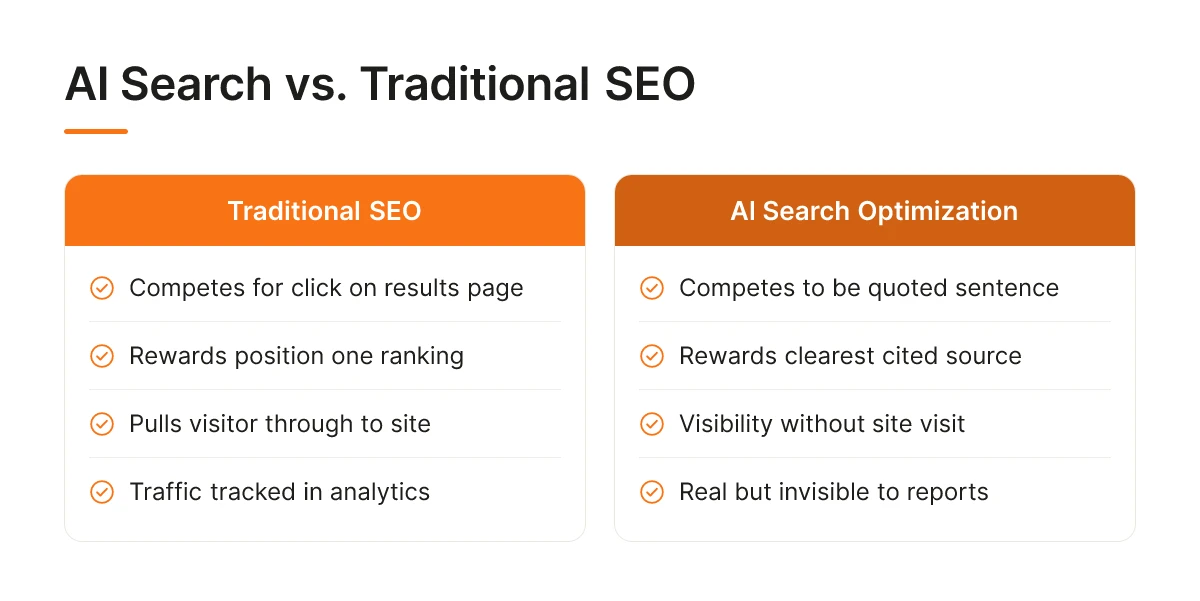
Google SEO competes for a click on a results page; ai search optimization competes to be the sentence an AI engine quotes before the reader ever visits a site.
Traditional ranking rewards a page that earns position one and pulls a visitor through. AI engines like ChatGPT, Gemini, and Perplexity work differently: they read dozens of sources, synthesize an answer, and cite the ones that gave them the clearest facts. Your business can be the cited source without a single click recorded in Google Analytics, a form of visibility that's real but invisible to traditional traffic reports.
Backlinks still matter, but they stop being the deciding factor. AI systems weigh how clearly a page states a fact, how consistently that fact appears across the web, and how easy the structure is to parse. Google's own guidance confirms that generative features in Search are built on its core ranking and quality systems, so foundational SEO practices still apply [1]. But a page stuffed with links and thin on direct, structured answers won't get picked up the same way an AI engine picks up a clearly labeled fact.
Is Traditional SEO Still Worth the Investment?
Yes, traditional SEO is the foundation AI search visibility is built on, not a separate investment to abandon.
Google has said directly that SEO best practices remain relevant because its generative AI features rely on the same core ranking and quality systems as standard search [1]. Fast pages, clean site architecture, and authoritative content still help AI crawlers find and trust a business. The difference is what gets layered on top: schema markup, consistent facts across sources, and content written to be quoted rather than just ranked.
What Tactics Work for AI Search but Not for Google?
Several tactics move the needle for AI citations while doing almost nothing for a Google ranking position.
- Direct-answer blocks: A concise, standalone paragraph that answers one question fully is more quotable to an AI engine than a long narrative lead-in.
- Cross-source fact consistency: Keeping your hours, pricing tier, service area, and claims identical across your site, directory listings, and review platforms builds the factual confidence AI systems look for.
- Structured data and llms.txt: These technical signals tell AI systems exactly what a business does, something a backlink profile alone can't communicate.
The ROI math changes too. Instead of tracking click-through rate alone, SMBs need to track how often their brand is mentioned or recommended across AI engines, which is the exact gap Moonrank's visibility tracking is built to close for ecommerce and B2B SaaS teams that have no other way to see it [2]. For more information, see Search.
Which AI Search Engines Should SMBs Prioritize?
Prioritize based on how each engine retrieves answers, not its size, ChatGPT, Gemini, Perplexity, and Claude pull from different sources, so your ai search optimization approach has to flex by platform and industry.
How Do ChatGPT, Gemini, Perplexity, and Claude Rank Content Differently?
Some engines lean heavily on real-time web retrieval, pulling fresh pages at the moment someone asks a question. Perplexity is built around live citation of current web sources, which means recently published or recently updated content has a real shot at surfacing. Gemini sits inside Google's own ranking and quality systems, so standard SEO fundamentals, crawlability, clear structure, authoritative signals, still carry weight even inside generative features [1].
Claude and ChatGPT behave differently depending on whether they're answering from trained knowledge or actively browsing. When they browse, freshness and structured data matter the way they do for Perplexity. When they answer from trained knowledge, your brand's presence in widely cited, well-established sources matters more than what you published last week. That's why Semrush frames this as a shift from ranking well in results pages to getting cited and positioned inside generated answers [2], the mechanics of "showing up" aren't the same mechanics as classic SEO.
Do Different Industries Need Different AI Search Strategies?
Yes, a single content template won't satisfy how differently each industry gets evaluated and cited. The retrieval behavior that works for one vertical can actively work against another.
- Ecommerce: Needs product-level clarity, specific attributes, pricing, availability, and real customer reviews that an engine can quote directly when someone asks for a recommendation.
- B2B SaaS: Needs comparison and feature-depth content. Buyers increasingly let chatbots shape vendor shortlists before they ever visit a site [3], so your content needs to answer "how does this compare to X" directly.
- Cybersecurity: Needs authoritative technical accuracy. Engines weigh expertise signals heavily in a category where a wrong answer carries real risk, so vague marketing copy underperforms precise technical detail.
- Hotels: Needs local and availability-style clarity, location, amenities, booking specifics, the kind of structured facts an engine can answer instantly rather than summarize loosely.
Generic, one-size-fits-all content fails because each industry gets judged on different evidence: reviews for retail, technical depth for security, comparisons for software, availability for hospitality. Moonrank builds its keyword research and content generation around each business's specific niche rather than applying a generic template, which is the practical difference between content that gets cited and content an engine skips over.
What Technical and Content Changes Improve AI Search Visibility?
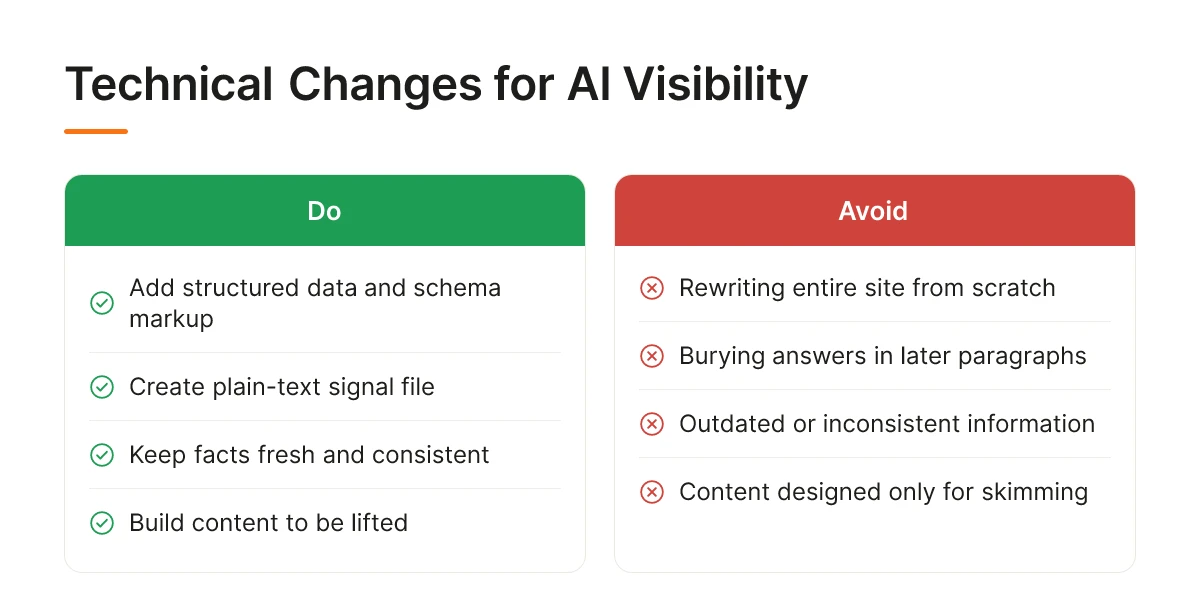
The concrete work behind ai search optimization comes down to four things: structured data, a plain-text signal file, fresh and consistent facts, and content built to be lifted into an answer rather than skimmed by a person. None of this requires rewriting a site from scratch.
What Structured Data and Schema Types Help AI Search?
Schema markup is structured data you add to your site's code that tells AI engines exactly what your business does, in a format machines parse faster than prose. Google's own guidance confirms that generative AI features on Search still rely on the same core ranking and quality systems that power traditional results, which means the foundational SEO signals, including structured data, still matter [1].
A few schema types do most of the work for small businesses. Organization schema states your business name, address, phone number, and hours in a format AI engines can quote directly. Product schema lists price, availability, and specifications for an e-commerce catalog. FAQ schema marks up question-and-answer pairs so an engine can extract one answer without guessing at context. Review schema surfaces ratings and testimonials as verifiable trust signals rather than buried text. Industry guidance increasingly treats this kind of technical groundwork as a baseline requirement for AI visibility, not an optional add-on [2].
A plain-text file called llms.txt is an emerging signal some AI crawlers reference to understand a site's structure and priority content, similar in spirit to a robots.txt file. Adoption is still uneven across AI engines, so treat it as a useful addition alongside schema and clean site structure, not a guaranteed fix on its own.
How Do Freshness and Citation Patterns Affect Visibility Over Time?
AI engines favor facts that have been recently verified, and they tend to drop or downrank sources once information goes stale or contradicts newer data published elsewhere. This is citation decay: a business listed with last year's hours, an outdated price, or a discontinued product risks disappearing from an AI answer even if it ranked there months earlier. Research on AI search behavior notes that brands now get filtered and summarized by generative engines before a prospect ever reaches the website, which raises the cost of outdated or inconsistent content [3].
Consistency across the web, the same name, address, hours, and core facts on your site, directories, and review platforms, functions as a trust signal that AI models cross-check before citing a source. A mismatch between your website and a listing on a directory or review site reads as a risk signal, not a rounding error.
Consider an unstructured FAQ buried in a paragraph: "We're open most days but closed on major holidays, call ahead during winter." Marked up as FAQ schema, it becomes a direct question-answer pair, "What are your holiday hours?" paired with a specific, dated answer, something an engine can lift cleanly instead of interpreting. This is the kind of groundwork Moonrank automates for SMBs: daily content generation paired with technical optimization, including schema markup, llms.txt setup, and citation consistency checks, so the structural work behind ai search optimization runs without manual upkeep.
What Tools and Metrics Help You Measure AI Search Optimization Results?
Measuring results takes a different scorecard than traditional SEO: track brand mention frequency, citation share, and answer accuracy instead of clicks, because AI engines rarely send direct traffic. A chatbot that recommends your restaurant or your SaaS product doesn't always generate a visit you can trace in Google Analytics, it generates trust before the click ever happens, or instead of it.
How Do You Measure ROI From AI Search Optimization?
Compare mechanisms, not just numbers, because AI citations and search rankings create value in different ways. A page one ranking on Google drives a visitor straight to your site, where you can measure sessions, conversions, and revenue in familiar terms. A citation inside a ChatGPT or Perplexity answer works earlier in the decision, it shapes which three options a buyer considers before they ever open a browser tab [3]. That's harder to track, but not impossible: if you sell to B2B buyers researching vendors conversationally rather than through search bars, a strong AI presence can shorten your sales cycle even without a measurable traffic spike. Semrush's guidance frames this shift bluntly, optimizing for AI systems now determines whether your content gets cited and recommended or stays invisible, regardless of click volume [2].
What Metrics Beyond Clicks Should You Track?
Track three things on a recurring basis: how often your brand gets mentioned, what share of citations in your category point to you versus competitors, and whether the engine's description of your business is accurate and current. Google itself points website owners toward Search Console to measure visibility in generative AI features, since standard analytics undercounts impact from AI Overviews and AI Mode [1].
Tools for this now span a wide range, from budget-friendly dashboards built for solo founders to enterprise platforms with deeper historical tracking and competitor benchmarking. Most work the same way: they run test prompts against ChatGPT, Gemini, Claude, and Perplexity, then log whether and how your business shows up. You can run a lighter version yourself, a monthly routine of five or six prompts a real customer might ask ("best [your category] in [your city/niche]"), logged in a spreadsheet to spot trends over time.
Moonrank builds this tracking in from the start. It monitors your brand across ChatGPT, Gemini, Claude, and Perplexity, then pairs that visibility data with daily content publishing and technical fixes, schema markup, llms.txt, citation building, so tracking and improvement run together instead of as separate tools. Visit www.moonrank.ai to see where your business currently stands.
Frequently Asked Questions
Can small businesses realistically compete with large brands in AI search results?
Yes, AI engines reward clear, well-structured, frequently-cited content over brand size or ad budget. A boutique hotel with precise schema markup and consistent publishing can outrank a national chain that has not optimized for AI-readability. The leveling factor is technical clarity, not marketing spend, which is why a budget-friendly automated approach can realistically compete with a far pricier agency retainer.
Do AI search engines use Google rankings as an input?
Partly, Google's own AI Overviews and AI Mode pull from its core Search ranking and quality systems, so traditional SEO fundamentals still matter there [1]. Tools like ChatGPT and Perplexity rely more on their own crawling, citations, and structured data rather than Google's position rankings directly.
How long does it take to see results from AI search optimization?
Most businesses start seeing citation changes within four to eight weeks of consistent technical fixes and content publishing. AI engines need to recrawl and re-index a site before new schema markup or fresh pages affect recommendations, so daily publishing speeds the timeline. Full visibility across ChatGPT, Gemini, and Perplexity typically takes longer than ranking in Google alone, since each engine indexes on its own schedule.
Should you write different content for AI search versus human readers?
No, the same clear, well-organized content serves both audiences, since AI engines favor the same directness and structure that helps human readers. Short paragraphs, specific answers, and credible sourcing work for a shop owner skimming on mobile and for an AI model parsing a page for citations.
Does AI search optimization require a developer to implement?
Not necessarily. Adding schema markup, cleaning up heading structure, and tightening answer-first paragraphs can often be done through a CMS's existing fields or a lightweight plugin, without custom code. More advanced work, like llms.txt setup or site-wide structured data audits, benefits from technical help, but the bulk of the content-side work is editorial, not engineering.
Conclusion
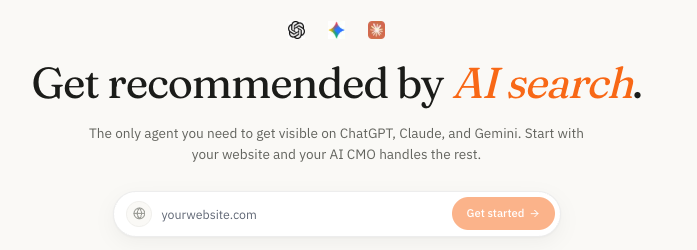
AI search visibility comes down to three things: technical readability (schema markup, llms.txt, structured data), consistent content publishing, and ongoing tracking of how ChatGPT, Gemini, Claude, and Perplexity actually describe your business. Skipping any one of these leaves gaps competitors can fill first. Most SMB owners don't have time to manage all three manually, which is why automation, not another hire, is the practical path forward. Start by checking how your business currently appears when you ask ChatGPT or Perplexity about your own category, then visit moonrank.ai to see what a fully automated fix looks like.
Sources & References
- Google's Guide to Optimizing for Generative AI Features on Google Search | Google Search Central | Documentation | Google for Developers
- How to optimize for AI search results in 2026
- AI Search Optimization: How to Make Your Brand AI-Visible | Walker Sands
Recommended Articles
Explore more from our content library: