Practical Guide to Choosing AI Search Optimization Services
Learn how AI search optimization services help your site get cited by ChatGPT, Gemini, and Perplexity through schema, content, and trust signals.

AI search engines like ChatGPT, Gemini, and Perplexity cite websites that clearly state what a business does, back it up with structured data, and are corroborated by independent sources like reviews, directories, and press mentions. For SMBs, ai search optimization services work by combining technical fixes (schema markup, clean site structure), content written to directly answer buyer questions, and third-party trust signals AI models weigh when picking which businesses to recommend. Results build over weeks to months, not overnight.
How AI Search Optimization Services Help Your Site Get Cited
AI models decide what to cite by checking whether a site's own claims match what independent sources say about it elsewhere. ChatGPT, Gemini, and Perplexity don't just read your homepage, they cross-reference it against reviews, directories, press mentions, and forum discussions before deciding your business is worth recommending.
This is the mechanism most SMB owners miss. A site can say "we're the top-rated plumber in Austin" all day, but if that claim never shows up on Google Business Profile, Yelp, or an industry directory, the model has no corroboration, so it skips the citation. Good ai search optimization services focus on closing that gap between what you say and what the rest of the internet confirms.
What Role Do Backlinks and Third-Party Trust Signals Play?
Backlinks still matter, but they work as trust corroboration rather than the ranking-weight mechanism they were built for in traditional SEO. A link from an industry publication or a local news site tells an AI model that a real third party vouched for your business, which carries more weight than link volume alone [5].
The same logic applies to reviews and directory listings. A consistent trail across Google Business Profile, Trustpilot, Capterra, or G2, depending on whether you're a local shop or a B2B SaaS vendor, gives the model multiple independent confirmations of the same facts about your business.
How Do AI Engines Handle Local Business Information?
AI engines parse local business details, name, address, phone number (NAP), hours, service area, by pulling them from multiple sources and checking for consistency, rather than leaning on a single ranked local pack like Google does [2]. If your NAP data differs across your website, Yelp listing, and Facebook page, the model may hesitate to recommend you at all, since it can't resolve which version is accurate.
This matters even more for home service and hospitality businesses, where AI assistants increasingly field "best plumber near me" or "best boutique hotel in [city]" queries directly [2]. Clean, matching data across every platform is the baseline requirement before any content work can help.
Narrow, well-defined topical authority also beats broad, diluted content. A handful of pages that clearly and specifically answer "what does this business do" outperform dozens of generic blog posts, because ambiguity is exactly what makes a model choose a competitor instead. None of this is one technique, it's technical fixes, targeted content, and off-site corroboration working together, which is why Moonrank bundles schema markup, llms.txt configuration, and citation building into a single automated process rather than treating them as separate projects.
What to Change on Your Website for AI Search Visibility
Five changes make a website eligible for AI citation: structured data, clean page structure, direct-answer content, an optional llms.txt file, and consistent facts across every page. Most SMB sites fail on two or three of these at once, which is why a competitor with a weaker product still gets recommended by ChatGPT instead.
- Structured data (schema markup): Organization, Product, FAQ, and LocalBusiness schema tell AI engines exactly what your business does instead of making them guess.
- Clean page structure: One topic per page, with a clear H1 and descending H2s, gives a model a clean unit of text to quote.
- Direct-answer content: Pages that answer the likely question in the first two sentences, in plain declarative statements a model can lift directly.
- An optional llms.txt file: A simple text file at your site's root that tells AI crawlers which pages matter and how to interpret your site's structure.
- Consistent facts across every page: Pricing, service area, and offerings need to match everywhere a model might cross-reference them.
Which Schema Markup and Metadata Changes Matter Most?
Schema markup is structured data, code added to your pages that tells AI engines exactly what your business does, sells, or charges, instead of making them guess from paragraphs of text. Four types matter most for SMBs: Organization schema (name, address, contact info), Product schema (price, availability, reviews), FAQ schema (question-answer pairs), and LocalBusiness schema (service area, hours, category). A Shopify store without Product schema is asking an AI model to infer price and stock from a product description, and models skip ambiguity in favor of a competitor who made it explicit.
Metadata matters almost as much as the schema itself. Page titles should describe one topic in plain language, "Returns Policy" beats "Our Promise to You", because AI crawlers extract answers from pages that match a query cleanly. One topic per page, with a clear H1 and descending H2s, gives a model a clean unit of text to quote rather than a mixed bag of services and FAQs it has to untangle.
How Should Content Strategy Change for AI Consumption?
Content built for AI citation answers the likely question in the first two sentences, in plain declarative statements a model can lift directly. A B2B SaaS pricing page that opens with "Our platform integrates with over 40 tools" gives an AI engine nothing to quote with confidence; a page that opens with a specific, concrete statement about cost and inclusions gives it a complete, citable fact. This is the core shift behind ai search optimization services: writing for extraction, not persuasion, and putting the answer before the pitch.
Emerging files like llms.txt are a low-effort, optional signal worth adding, it's a simple text file at your site's root that tells AI crawlers which pages matter and how to interpret your site's structure, similar in spirit to a sitemap. It won't substitute for real content or schema, but it removes friction for engines trying to parse a site.
Last, consistency matters more than most SMBs assume. If your pricing page says one tier and your FAQ page or a review site references another, AI models, which cross-reference multiple sources before recommending a business, treat the contradiction as a trust signal against you [4]. Service area, offerings, and pricing need to match everywhere, every time. For more information, see Search.

How Long Until You See AI Search Citations and Traffic
Most businesses see technical fixes take effect within days, early citations within four to eight weeks, and compounding visibility build over three to six months. The exact timeline depends on how each AI engine pulls its information.
What's a Realistic Timeline for First Citations?
Some AI engines retrieve live web data at the moment someone asks a question, while others lean on a training snapshot that only updates periodically. Perplexity, for example, is built around real-time retrieval, it's constantly pulling fresh pages rather than waiting on a model refresh. That means a schema fix or new page can show up in a Perplexity answer within days. A model relying more heavily on its training data will take longer to reflect the same change, sometimes not until its next update cycle.
Given that variation, think in three phases:
- Weeks one and two: Technical fixes go live, schema markup, llms.txt, cleaned-up structured data, so AI crawlers can parse the site correctly.
- Weeks three through eight: Early citations start appearing, often inconsistently, as retrieval-based engines pick up the new signals first.
- Months two through six: Visibility compounds as more pages accumulate citations, more third-party sources reference the business, and trust signals stack up across engines.
This phased pattern is why ai search optimization services tend to get framed as an ongoing process rather than a one-time project, the trust signals that drive recommendations build cumulatively, not instantly.
How Do You Measure AI Search Visibility Before Results Show?
Don't wait for a traffic spike to know whether progress is happening. Manually prompt ChatGPT, Gemini, Claude, and Perplexity with the exact questions a buyer would ask, "best [product] for [use case]" or "top [niche] company near me", and note whether the business appears, and where. Check analytics for referral traffic from perplexity.ai, chatgpt.com, or gemini.google.com, which shows up as a distinct source once AI engines start sending clicks.
Watch for an early, easy-to-miss signal: being mentioned by name without a clickable link often shows up before a full citation with a source link does. That's a sign the engine recognizes the brand but hasn't yet built enough confidence to cite it directly. Moonrank's visibility tracking layer monitors this shift across all four engines automatically, so businesses can see the mention-to-citation progression without manually testing prompts every week.
Which AI Platforms to Prioritize and How Their Citation Rules Differ
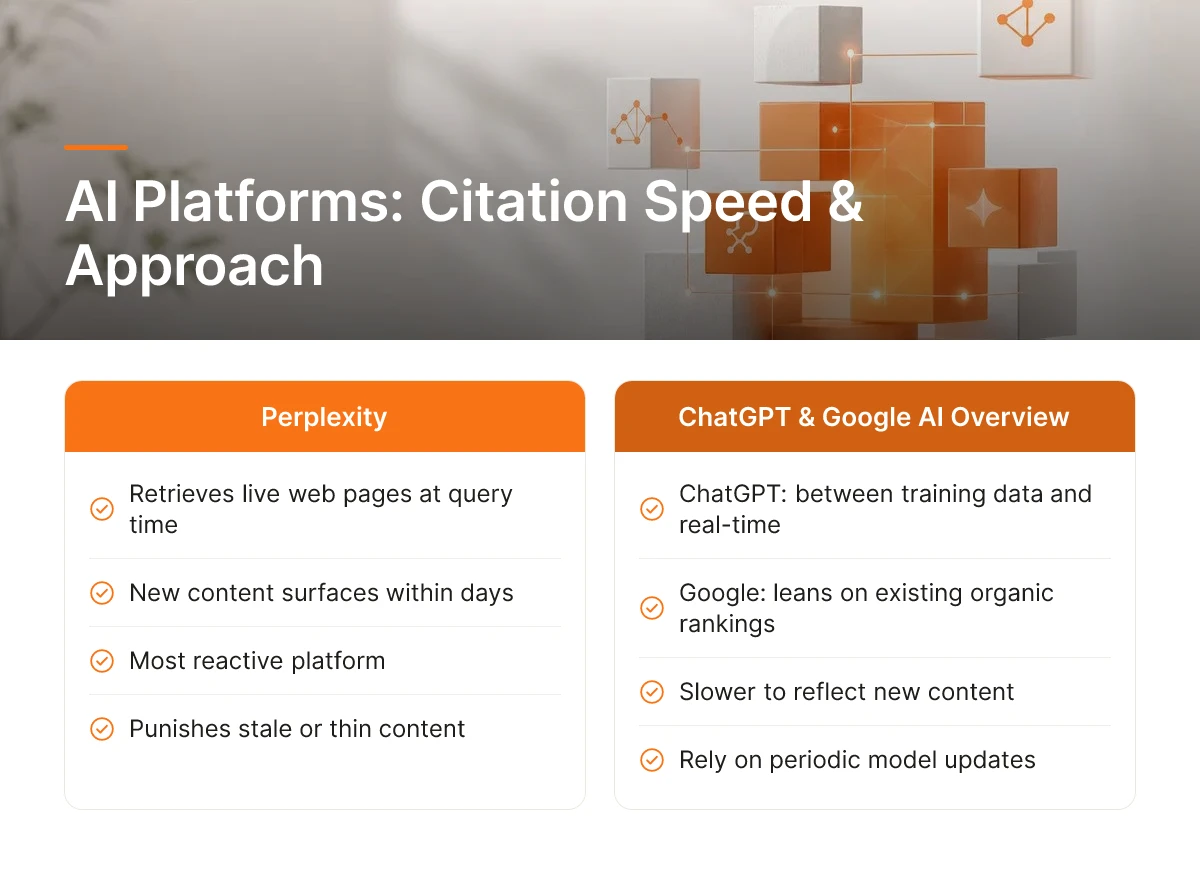
Perplexity pulls from live web pages at query time, Google AI Overviews leans on existing organic rankings, and ChatGPT sits somewhere between training data and real-time browsing, each demands a different approach.
Is It Harder to Get Cited by ChatGPT, Perplexity, or Google AI Overviews?
Perplexity is the most reactive of the three. Because it retrieves fresh pages from the live web for most queries, new content, a product update, a comparison page, a fresh blog post, can surface in Perplexity's answers within days, not months. This makes it the fastest platform to influence but also the one that punishes stale or thin pages the hardest, since it is re-crawling and re-ranking sources constantly.
ChatGPT works differently. It blends pretraining knowledge with browsing when a query triggers web search, which means well-established brand mentions and citations built up over time still carry weight alongside recent content [5]. A new page won't necessarily show up in ChatGPT's answers as quickly as it might in Perplexity's, but durable signals, structured data, consistent citations across the web, clear service descriptions, compound over time.
Google AI Overviews is the most tied to legacy SEO of the three. It draws heavily from pages that already rank well organically, so traditional ranking factors, backlinks, page authority, on-page optimization, still feed it directly [1]. Businesses with no organic footprint rarely appear in Overviews regardless of how well-structured their content is for AI parsing.
Which Business Types See the Strongest ROI?
The right starting point depends on where a business's buyers actually search, not where a business owner assumes they search. A B2B SaaS company whose prospects research vendors conversationally should prioritize ChatGPT and comparison-style content. A boutique hotel whose guests ask trip-planning questions benefits more from Perplexity, where live retrieval rewards fresh local content and clear availability details.
Ecommerce brands with detailed product specifications, reviews, and structured data tend to see faster returns because AI engines can parse and cite that information cleanly. Cybersecurity firms answering technical, high-intent queries, "best SOC 2 compliance tool for a 50-person startup", also perform well, since these are exactly the specific, comparison-heavy questions AI search handles best [5]. This is where ai search optimization services earn their keep: aligning content and technical structure to how each platform actually sources answers, rather than treating every engine the same.
Industries built on long sales cycles, highly regulated claims, or sparse public data, think specialized B2B manufacturing or legal services with little online documentation, are seeing slower, less consistent returns. The retrieval mechanics favor businesses with rich, structured, frequently updated content, and that gap takes longer to close in categories where that content doesn't naturally exist yet.
AI Search Optimization vs Traditional SEO: Weighing the ROI
AI search optimization and traditional SEO draw on the same technical base, so most of the spend overlaps rather than doubling. Clean site structure, fast load times, clear headings, and well-organized content help Google rank you and help ChatGPT or Perplexity understand and cite you. Schema markup and structured data serve both goals too, a well-tagged product page or service listing is easier for Google's crawler and an LLM's retrieval system to parse. The incremental cost of layering AI visibility on top of a solid SEO foundation is smaller than it looks, because you're not starting from zero.
How Much Should You Budget: Software vs Agency?
Three budget tiers cover most of the market, and each fits a different stage of business. Budget-friendly self-serve tools suit a solo founder or small Shopify store that needs automated content and basic technical fixes without a learning curve. Mid-range platforms add deeper competitive tracking and more customization, aimed at growing e-commerce brands or B2B SaaS teams with some marketing bandwidth. Premium and enterprise agency retainers sit at the top, offering custom strategy and hands-on account management, the kind of engagement referenced by agencies like WebFX, which position GEO as a full-service add-on to existing SEO contracts [1]. The agency tier makes sense for companies with complex, multi-market visibility needs; it's overkill for a hotel or boutique retailer trying to show up in one or two AI assistants.
What's the Cost-Benefit Case for SMBs?
The ROI mechanism behind AI search optimization services is different from classic SEO, and that difference matters for budgeting. A Google search sends a visitor who still has to compare options; an AI citation sends a visitor who already read a summary of your business and chose to click through anyway. That traffic volume is usually smaller, but the intent is higher, the user has effectively been pre-qualified by the AI's own recommendation. Industry case studies describe this as a shift in share of voice rather than raw traffic, with one marketing team reporting movement from fifth to third place in AI citations after sustained technical and content work [3].
Budgeting should follow team capacity, not just channel preference. AI visibility isn't a one-off project, it needs ongoing technical monitoring, llms.txt upkeep, and regular content refreshes, since AI models re-crawl and re-summarize constantly. An agency retainer structured around occasional audits won't keep pace with that cadence unless it's built for continuous work. Moonrank addresses this gap directly: it runs daily automated content publishing, tracks visibility across ChatGPT, Gemini, Claude, and Perplexity, and handles the technical optimization work in the background, a budget-friendly way to stay visible without agency overhead or a dedicated marketing hire. For SMBs weighing a modest monthly spend against a retainer priced for enterprise accounts, that math is usually the deciding factor.

Frequently Asked Questions
Do I need to abandon traditional SEO to focus on AI search optimization?
No, you need both working together, not one replacing the other. AI engines like Perplexity and ChatGPT often pull from the same indexed, well-structured content that ranks in Google, so a site with weak technical SEO will struggle in both places. Think of AI visibility as an added layer on top of solid SEO fundamentals, not a swap.
Can a small business with no technical team realistically do this work?
Yes, but only with tools built to automate the technical parts, since manual schema markup and llms.txt setup require skills most owners don't have. Moonrank, for example, runs this work automatically, handling structured data and daily content publishing without the owner writing or coding anything.
Does getting cited by an AI engine actually bring in sales, or just visibility?
Citations matter most when they lead to a recommendation, which is the step that actually drives clicks and bookings. One case study found a company moved from fifth to third place among competitors for total AI citations while increasing its share of voice across Perplexity and Gemini [3]. Visibility without a clear, structured business description rarely converts, so the content quality behind the citation matters as much as the citation itself.
How is AI search optimization different for a hotel versus a B2B SaaS company?
A hotel needs AI engines to answer local, comparison-based questions, while a SaaS company needs AI engines to recommend it by name in vendor shortlists. Hotels benefit from structured data around amenities, location, and reviews, similar to other local service businesses [2]. SaaS companies rely more on content that ties product positioning to buyer intent, since AI recommendations for software increasingly get measured against pipeline impact, not just traffic [5].
How often does AI search optimization content need to be updated?
Treat it as an ongoing cadence rather than a set-and-forget task, since AI engines re-crawl and re-summarize sites on their own schedules. Pages tied to pricing, service details, or availability need the most frequent review, since inconsistencies there are the fastest way to lose a model's trust. A monthly review cycle, paired with immediate fixes to any factual mismatch, keeps citations from quietly going stale.
Conclusion
AI search optimization works best as a combination of technical fixes, consistent content, and visibility tracking across ChatGPT, Gemini, Claude, and Perplexity, not a one-time project. The businesses gaining ground are the ones publishing regularly, fixing structured data gaps, and watching how competitors show up in AI recommendations. Skipping any one of those three leaves citations on the table.
Start by checking how your business currently appears when you ask ChatGPT or Perplexity about your category. If you're invisible or your competitor shows up first, visit moonrank.ai to see how automated daily optimization can close that gap.
Sources & References
- AI Search Optimization Services & GEO Services
- AI Search Engine Optimization Services Explained
- AI Search Optimization Agency | Get Cited by ChatGPT
- AI Search Optimization Services for Accurate AI Recommendations | Blueleaf Creative
- The 7 Best AI SEO Agencies Helping Clients Win AI Search in 2026 | Optimist
Recommended Articles
Explore more from our content library: