Best AI Search Engine Optimization Tools for Small Business
The best AI search engine optimization tools for small businesses combine automated content publishing, technical optimization, and visibility tracking into...

The best AI search engine optimization tools for small businesses combine automated content publishing, technical optimization, and visibility tracking into one affordable platform rather than requiring separate enterprise tools and agency fees. Enterprise platforms like large SEO suites offer deep analytics but demand significant budgets and in-house expertise. For SMBs without a dedicated SEO team, an all-in-one autopilot tool, like Moonrank at a flat monthly rate, delivers daily content, structured data fixes, and tracking of how ChatGPT, Gemini, and Perplexity mention your business, without the learning curve or agency markup.
Quick Picks: Best AI Search Engine Optimization Tools for Small Businesses
Here is the short version: Moonrank wins for SMBs on price and automation, while the enterprise platforms win only if you already have an SEO team to run them.
We sorted these AI search engine optimization tools by who actually needs them, not by feature count. A solo founder running a Shopify store has a different job to do than a marketing director at a 200-person SaaS company, and the right tool depends more on your team size and budget than on which platform has the longest feature list.
- Moonrank, Best overall for SMBs: automated daily content, technical optimization, and visibility tracking across ChatGPT, Gemini, Claude, and Perplexity for a flat monthly rate, with zero manual input required after setup.
- Semrush, Best for teams that already run Semrush for traditional SEO and want AI visibility reporting folded into the same dashboard, provided someone on staff has time to interpret it [2].
- Profound, Best for enterprise marketing teams that need granular prompt-level intelligence on how real users phrase questions to AI assistants [2].
- Ahrefs, Best for SEO specialists who want backlink and keyword depth first, with AI search features as a secondary layer rather than the core product.
- Peec AI, Best for agencies and multi-brand teams that need to track several client brands' prompt rankings side by side [2].
- AthenaHQ, Best for larger organizations that want a dedicated analyst-style view of AI citation data, typically paired with an in-house content team to act on the findings.
Notice the pattern: five of these six picks assume a marketing department, a budget line for software stacking, and someone whose job is to read reports and brief writers. That setup works for a venture-backed SaaS company or a cybersecurity vendor with a content team. It does not work for a hotel owner managing bookings and staff, or a solo founder who already wears five hats.
Moonrank is built for the second group. It replaces the research-plus-writing-plus-publishing-plus-tracking workflow that the other tools expect you to run yourself, automating it end to end so the business owner never opens a dashboard to assign tasks. The rest of this guide breaks down what each tool actually does, what it costs, and who should, and shouldn't, pick it.
What Are AI Search Engine Optimization Tools and How Do They Differ From Traditional SEO Software?
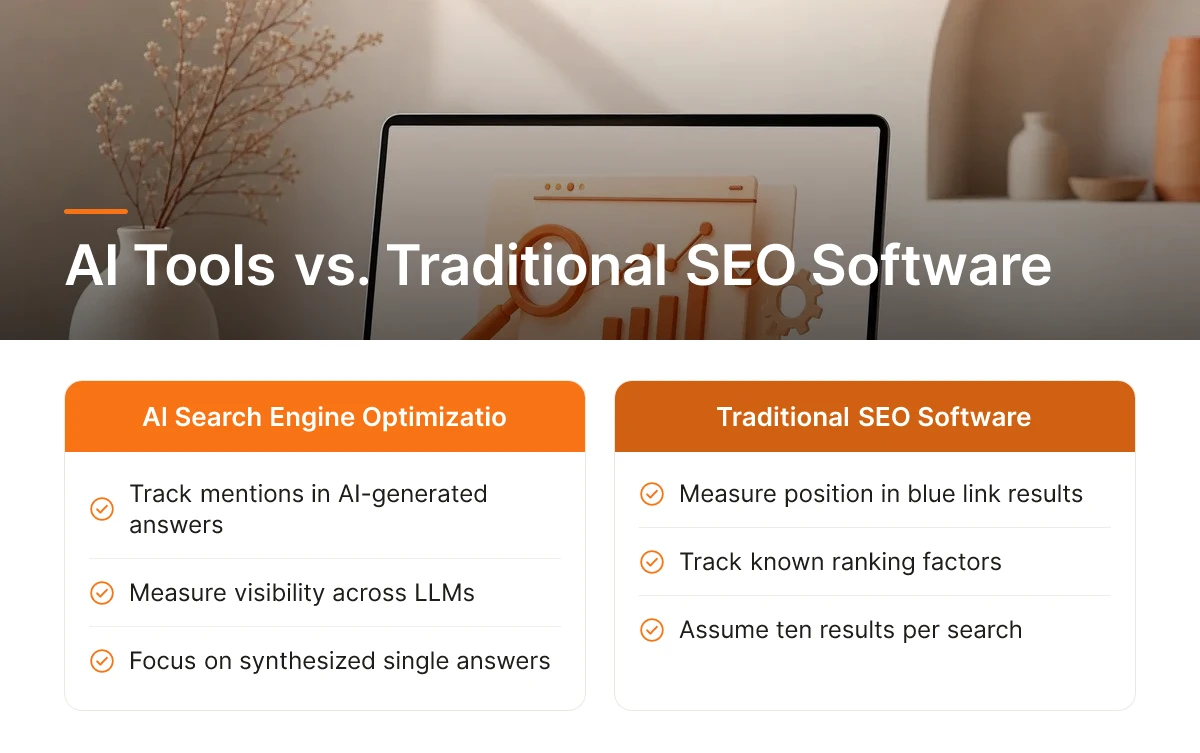
AI search engine optimization tools track whether a business gets mentioned inside an AI-generated answer, not where its web page lands in a list of blue links.
Traditional SEO software, think rank trackers and backlink checkers, measures position against a known set of ranking factors: keyword density, domain authority, link profiles. That model assumes a search engine returns ten results and a human scans them. Assistants like ChatGPT, Claude, and Perplexity work differently. They synthesize a single answer by pulling from structured data, pages written with clear and specific claims, and sources the model treats as citation-worthy [2]. There's no list to climb. Either the model surfaces the business by name or it doesn't.
Why Is Getting Recommended by AI Search Engines Different From Ranking on Google?
A top-10 Google ranking and an AI recommendation measure two separate outcomes, even when they pull from overlapping content. Google ranking rewards a page for matching a query well enough to earn a click among competing results. An AI answer skips the click entirely, the assistant reads the page, decides it's trustworthy and specific enough to cite, and repeats the business's name directly to the user. Rankability's own research frames this as two jobs happening at once: optimizing content for traditional engines and separately tracking whether a brand shows up in AI answers from ChatGPT, Gemini, and Perplexity [4]. Semrush's GEO coverage makes a similar distinction, treating AI citation tracking as a discipline worth measuring alongside, not instead of, classic rank tracking [2].
What Technical and Content Changes Help a Business Appear in AI Search Results?
Two layers determine whether an AI engine recommends a business: content clarity and technical signal strength. Content has to state facts plainly enough for a model to extract and repeat them with confidence, vague marketing copy rarely gets cited. Technical signals, including structured data, schema markup, and clean site architecture, tell the crawler what the page actually means, reducing the guesswork a model has to do before trusting a source. Neither layer works alone. A well-written page with no structured data can still get skipped, and perfect schema markup can't save thin or outdated content. Scrunch, for instance, builds its product around optimizing how AI agents consume a site's existing content, separate from the content creation itself [1].
Most small business owners don't abandon Google SEO to chase AI visibility, they run both. A Shopify store still needs organic search traffic from shoppers typing product queries into Google, while also needing to show up when someone asks an assistant for a recommendation in the same category. The tools in this guide split roughly along that line: some extend existing SEO platforms with AI tracking bolted on, others, including Moonrank, build the entire stack, content, technical optimization, and visibility monitoring, specifically around how AI assistants choose who to recommend.
1. Semrush, Review
Semrush is a full-spectrum marketing platform that bundles keyword research, backlink analysis, and AI visibility tracking into one subscription built for larger marketing operations.
Semrush began as a Google-era keyword and backlink tool and has since added modules for tracking how brands appear in AI-generated answers, positioning itself as one of the broader AI search engine optimization tools on the market today. Its suite now covers competitor research, site audits, rank tracking, content planning, and a dedicated AI visibility layer that reports on brand mentions across large language models [2].
Features
- Keyword research and SERP tracking across traditional and AI-driven search results
- Backlink analysis and domain authority scoring
- AI visibility tracking that measures brand mentions in generative answers [2]
- Site audit tools for technical SEO issues
- Content marketing and campaign management dashboards
Pros and Cons
- Pro: Depth of data is hard to match, few platforms combine backlink history, keyword volume, and AI mention tracking in a single login.
- Con: The number of dashboards and reports demands real marketing expertise to interpret; a solo founder without that background can lose hours just figuring out which metric matters.
Pricing
Semrush sits firmly in the premium/enterprise tier. It's built for teams with dedicated marketing staff who can divide the workload across specialists, not a single owner managing everything else in the business too.
Best For
Semrush fits larger businesses or agencies managing multiple client accounts or brand portfolios, where the cost spreads across a team and the complexity becomes a feature rather than a burden. For a restaurant owner or Shopify seller running the business alone, that same depth often translates into unused reports and a steep onboarding period.
2. Ahrefs, Review
Ahrefs remains one of the deepest backlink and keyword research platforms available, now layering in AI overview tracking without changing its core data-first design.
For over a decade, Ahrefs built its reputation on crawling the web and mapping link graphs and keyword rankings at scale. That foundation hasn't gone away, it's still the reference point many SEO specialists use to audit backlink profiles, find content gaps, and benchmark competitors. The newer additions, including features that track how brands surface in AI-generated overviews, extend that data engine into the AI search conversation rather than replacing it.
Features
- Site Explorer for backlink profiles and referring domain analysis
- Keywords Explorer with search volume, difficulty, and click metrics
- Content Explorer for identifying high-performing topics in a niche
- AI overview and brand mention tracking layered onto existing rank reports
- Site audit for crawlability and technical SEO issues
Pros and Cons
- Pro: Among the most complete keyword and backlink datasets on the market
- Pro: Strong for competitive gap analysis and content planning
- Con: Surfaces data but doesn't automate content publishing or apply technical fixes, a specialist still has to interpret reports and execute every change manually
- Con: No autopilot workflow for business owners without time to run a research-to-action loop every week
Pricing
Ahrefs sits in the mid-range to premium tier depending on the plan, with costs scaling as seat count and crawl volume increase, a structure built around teams running continuous campaigns, not a single owner checking in occasionally.
Best For
Content teams and in-house SEO specialists who want raw, exportable data they can act on themselves. It's a strong research companion among AI search engine optimization tools, but it assumes a skilled operator on the other end of the dashboard.
That's the gap Moonrank is built to close. Instead of handing an owner another dashboard to interpret, Moonrank runs daily automated content generation, technical fixes like schema markup and llms.txt configuration, and visibility tracking across ChatGPT, Gemini, Claude, and Perplexity, on autopilot, for $99/month, with no agency and no manual report-reading required.
How to Choose the Right AI SEO Tool: Buying Guide for Small Businesses
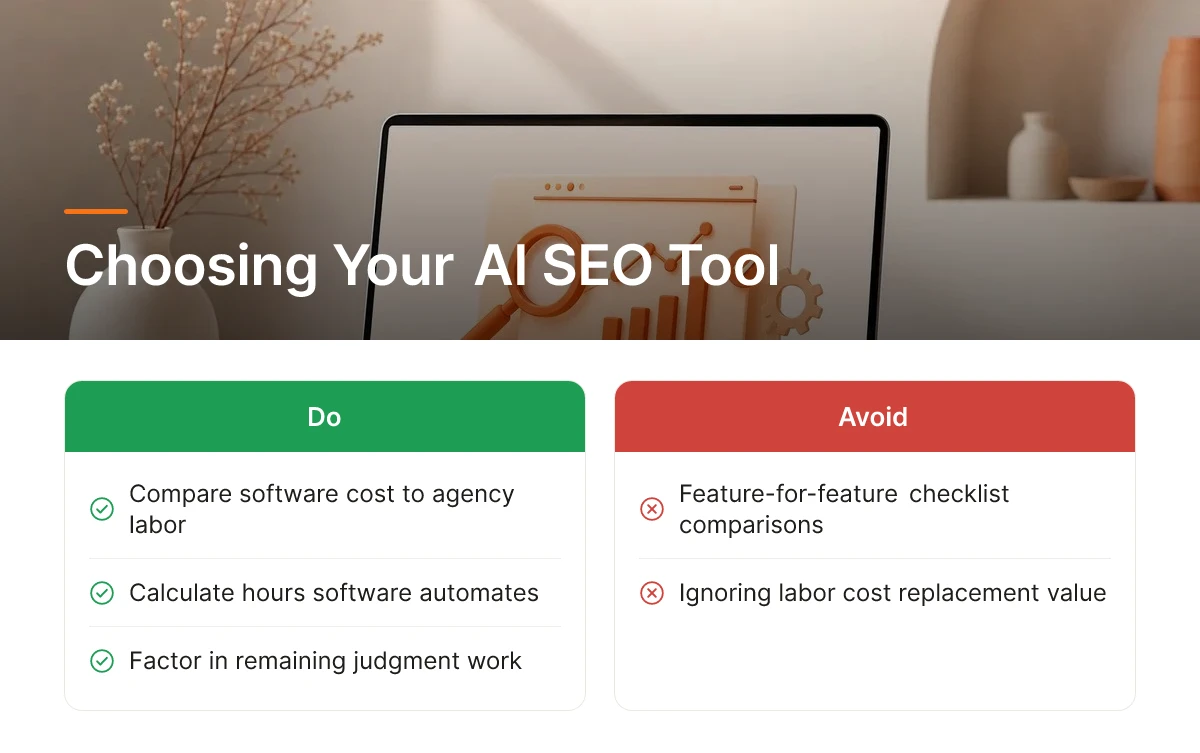
The right choice comes down to one calculation: what does a human agency charge for labor that software can now automate, and what's left over that still needs a person's judgment.
Agency retainers price in strategy calls, manual content calendars, and someone logging into a CMS to hit publish, hours billed at agency rates, often totaling thousands per month [2][4]. A flat-fee automated platform replaces that labor directly: daily content generation, auto-publishing, and visibility tracking run on a schedule instead of a timesheet. That's the real comparison, not feature-for-feature checklists.
What Should You Look for When Choosing an AI SEO Tool for Your Business?
Start by separating tools that report problems from tools that fix them. A dashboard showing your brand is missing from AI answers is useful, but if nobody on staff has time to rewrite pages, add schema, or publish new content based on that data, the insight sits unused, and that unused insight is still a labor cost, just a hidden one. Several AI visibility platforms built for enterprise marketing teams fall into this trap: strong on tracking and prompt-level reporting, light on execution [2][3].
- Automated publishing, does the tool create and publish content, or only recommend what you should write?
- Technical handling, does it manage schema markup, llms.txt, and structured data, or leave that to a developer?
- Visibility tracking across named engines, does it monitor ChatGPT, Claude, Gemini, and Perplexity specifically, not just generic "AI search" mentions?
- Transparent flat pricing, no custom quotes, no annual lock-in, no seat-based upcharges.
One caveat: full automation isn't right for every claim a business makes. Cybersecurity vendors and hospitality operators often work under compliance language, licensing disclosures, or liability-sensitive copy, that content still benefits from a human review pass before it goes live, even when the drafting itself is automated.
How Do Results Differ Across Industries Like E-commerce, SaaS, and Hospitality?
The target audience matters as much as the tool. An ecommerce store needs product-level visibility at scale, structured data across hundreds of SKUs so an AI engine can recommend the right item, not just the homepage. A B2B SaaS company needs feature breakdowns and comparison content that answer "what does this do better than the alternative." A hotel needs location- and amenity-specific answers, "pet-friendly hotels near the airport", rather than generic brand mentions. Generic AI search engine optimization tools that treat every business the same miss this; the ones worth paying for adapt keyword research and content structure to the niche.
This is where the cost-benefit math resolves for most SMBs. Enterprise platforms like Semrush, Ahrefs, Profound, or Peec AI offer deep tracking and analysis, but typically require a specialist to interpret the data and a separate content team to act on it [2][3], stacking tool cost on top of labor cost. Moonrank removes that stack: for $99/month, it runs personalized keyword research, daily automated content generation, technical optimization, and visibility tracking across ChatGPT, Gemini, Claude, and Perplexity as one system, with no agency retainer and no second tool needed to close the loop between finding a gap and fixing it.
Frequently Asked Questions
What's the difference between AI SEO tools and Answer Engine Optimization (AEO) platforms?
AI SEO tools generally extend traditional keyword and ranking workflows with AI features, while AEO-style platforms focus specifically on how large language models retrieve, cite, and recommend brands. Tools like Semrush and Ahrefs sit closer to the first category [3]; platforms built around tracking ChatGPT and Perplexity citations, like Otterly and Peec AI, sit closer to the second [2].
How do you integrate AI search engine optimization into your existing SEO workflow?
Treat AI visibility as an added layer on top of existing SEO, not a replacement, structured data, fresh content, and citation-worthy pages help both channels. Most SMBs start by auditing technical readability (schema markup, llms.txt), then layer on tracking across ChatGPT, Gemini, Claude, and Perplexity to measure results.
What before-and-after results can small businesses realistically expect from AI search optimization?
Expect gradual gains in brand mentions and citations within AI answers rather than overnight traffic spikes. Since roughly 40% of Google searches now end without a click as users shift toward AI-generated answers [2], the realistic win is appearing inside those answers consistently, tracked month over month, rather than chasing a single ranking position the way traditional SEO measures success.
Is Moonrank a good fit for e-commerce and B2B SaaS businesses specifically?
Yes, Moonrank is built for exactly this kind of business: Shopify stores, B2B SaaS companies, and other SMBs without an in-house SEO team. Its daily automated content generation, keyword research tailored to a store's or product's niche, and technical AI optimization run on autopilot, so an owner-operator gets AI search visibility tracking across ChatGPT, Gemini, Claude, and Perplexity without hiring an agency or learning schema markup.
Conclusion
Enterprise platforms like Semrush, Profound, Ahrefs, Peec AI, and AthenaHQ offer real depth for teams with dedicated SEO staff and budget to match. But depth isn't the bottleneck for most SMBs, time and cost are. The practical takeaways: pick a tool that tracks citations across ChatGPT, Gemini, Claude, and Perplexity (not just Google rankings), confirm it handles technical fixes like schema markup without manual work, and weigh total cost against what an agency would charge. If that math points toward automation, visit www.moonrank.ai and start a 3-day free trial today.
Sources & References
- Scrunch | FAQs - What products does Scrunch offer for AI search optimization?
- The 9 Best Generative Engine Optimization (GEO) Tools of 2026
- 13 Best AI SEO Tools in 2026
- 15 Best AI SEO Tools for 2026 (Tested, With Pricing)
Recommended Articles
Explore more from our content library: