Google Gemini SEO: Complete Guide to AI Search Optimization
Master Google Gemini SEO with our complete 2026 guide. Learn AI search optimization strategies, best practices, and tools to boost visibility. Discover.
| Key Insight | Explanation |
|---|---|
| AI-First Search Evolution | Google Gemini represents a fundamental shift toward AI-powered search results that prioritize direct answers over traditional website listings |
| Content Structure Matters | Structured data, clear headings, and answer-focused content perform better in Gemini's AI-driven result generation |
| Zero-Click Impact | Gemini's AI Overviews reduce click-through rates by 20-30% as users get answers directly in search results |
| Entity Optimization | Businesses must focus on entity recognition and knowledge graph signals to appear in AI-generated responses |
| Multi-Platform Strategy | Success requires optimization across Google Gemini, ChatGPT, Claude, and Perplexity simultaneously |
| Automated Solutions | AI search optimization demands consistent, automated content creation and technical optimization at scale |
What Is Google Gemini SEO?
Google Gemini SEO is the practice of optimizing websites and content to appear prominently in Google's AI-powered search results generated by the Gemini language model. Unlike traditional SEO that focuses on ranking web pages, this approach targets how AI systems understand, process, and cite your content when generating direct answers for user queries.Understanding the AI Search Evolution
Google's Gemini model represents a fundamental shift in how search engines deliver information. Rather than simply displaying a list of relevant websites, Gemini analyzes content across the web and synthesizes comprehensive answers directly in search results. This means your content needs to be structured and optimized for AI comprehension, not just human readers. The implications are significant. Research indicates that Gemini's AI Overviews are reducing click-through rates by providing complete answers within the search interface. Businesses that don't adapt their SEO strategies risk becoming invisible in this new search paradigm.Key Differences from Traditional SEO
Traditional SEO focuses on keyword density, backlinks, and page authority signals. AI search optimization emphasizes:- Structured data markup that helps AI understand content context
- Entity-based optimization targeting specific concepts and relationships
- Answer-focused content that directly addresses user questions
- Schema markup that provides clear content categorization
- Citation-worthy information that AI models can confidently reference
Pro Tip: Focus on creating content that answers specific questions comprehensively. Gemini prioritizes sources that provide complete, accurate information over those optimized solely for keywords.
How Google Gemini SEO Works
AI search optimization operates through AI's natural language processing capabilities that analyze content semantic meaning, entity relationships, and factual accuracy to determine which sources deserve citation in generated responses.The AI Content Analysis Process
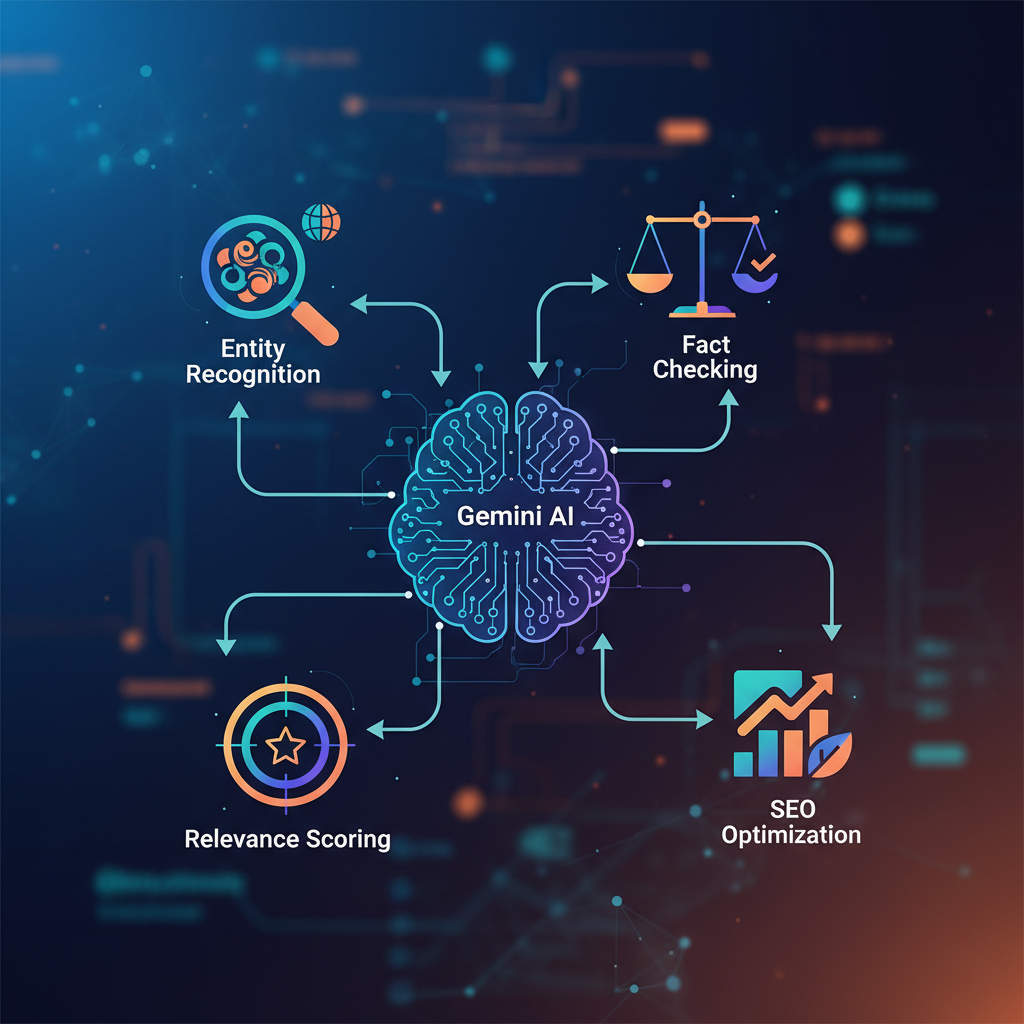
When users submit queries to Google, Gemini doesn't just match keywords—it understands intent and context. The AI model evaluates your content based on several factors:- Semantic relevance to the user's actual question
- Factual accuracy verified against multiple sources
- Content freshness and temporal relevance
- Entity recognition and relationship mapping
- Structured data quality and completeness
Ranking Factors Gemini Considers
Google Gemini evaluates content through sophisticated algorithms that assess multiple quality signals simultaneously. Understanding these factors helps you optimize effectively:| Ranking Factor | Weight | Optimization Strategy |
|---|---|---|
| Content Authority | High | Establish expertise through citations, credentials, and comprehensive coverage |
| Factual Accuracy | Very High | Cross-reference claims with authoritative sources and maintain accuracy |
| Structured Data | High | Implement comprehensive schema markup and JSON-LD |
| Content Freshness | Medium | Regular updates and timestamp optimization |
| User Engagement | Medium | Optimize for user satisfaction and interaction metrics |
Key Benefits: Why Google Gemini SEO Matters
AI search optimization delivers measurable business advantages by positioning your content as the authoritative source AI systems reference when generating responses to user queries.Increased AI Search Visibility
Businesses that optimize for AI search gain significant competitive advantages in AI-powered search results. When your content appears in Gemini's AI Overviews, you receive:- Premium placement above traditional search results
- Brand recognition through AI-generated citations
- Authority establishment as a trusted information source
- Increased organic traffic from high-intent users
- Improved conversion rates from qualified prospects
Competitive Advantage Through Early Adoption
Most businesses haven't yet adapted their SEO strategies for AI search engines, creating substantial opportunities for early adopters. Companies implementing AI search optimization now can:- Capture market share before competitors adapt
- Establish thought leadership in their industry
- Build authority that becomes harder to displace over time
- Develop optimization expertise that provides lasting advantages
Pro Tip: Start optimizing for AI search engines now while competition is limited. The businesses that establish authority early will be much harder to displace as AI search adoption accelerates.
Future-Proofing Your Business Visibility
AI search optimization isn't just about current search trends—it's about preparing for the future of information discovery. As AI systems become more sophisticated and widely adopted, businesses with optimized content will maintain visibility while others struggle to adapt. The investment in AI search optimization pays dividends across multiple AI platforms. The optimization principles that work for Gemini also improve performance in ChatGPT, Claude, and Perplexity, creating a comprehensive AI search strategy that protects your business regardless of which platforms users prefer.Common Challenges and Mistakes
AI search optimization presents unique obstacles that require different approaches than traditional search optimization, and many businesses make costly errors by applying outdated strategies to AI-powered search environments.Keyword Stuffing and Outdated SEO Tactics
The biggest mistake businesses make is treating AI search optimization like traditional keyword-based optimization. Common errors include:- Focusing on keyword density instead of semantic meaning
- Creating content for search crawlers rather than AI comprehension
- Ignoring entity relationships and topical authority
- Neglecting structured data implementation
- Prioritizing quantity over content quality and accuracy
Technical Implementation Challenges
Many businesses struggle with the technical aspects of AI search optimization. Common implementation challenges include:- Incorrect or incomplete structured data markup
- Poor website architecture that confuses AI crawlers
- Lack of entity optimization and knowledge graph signals
- Inconsistent content formatting across pages
- Missing citation and source attribution
Pro Tip: Invest in proper technical implementation from the start. Poor structured data can actually hurt your AI search performance more than having no markup at all.
Content Quality and Accuracy Issues
Google Gemini places extreme emphasis on factual accuracy and content quality. Businesses often underestimate how rigorously AI systems evaluate information credibility. Problems include:- Publishing unverified or outdated information
- Lacking proper source citations and references
- Creating thin content that doesn't provide comprehensive answers
- Failing to maintain content freshness and relevance
- Ignoring E-A-T (Expertise, Authoritativeness, Trustworthiness) signals
Best Practices and Expert Tips for 2026
AI search optimization success in 2026 requires implementing specific optimization strategies that align with AI search engines' content evaluation criteria and user intent understanding.Content Optimization Strategies
Effective AI search optimization content follows AI-friendly formatting and structure principles. Industry experts recommend focusing on E-E-A-T guidelines and helpful content creation when developing materials for AI search optimization. Essential content optimization techniques include:- Create comprehensive topic clusters that cover subjects thoroughly
- Use clear, descriptive headings that AI can easily parse
- Include specific facts, statistics, and data points with proper attribution
- Structure content with logical information hierarchies
- Implement FAQ sections that directly answer user questions
- Maintain consistent entity naming and definition throughout content
Technical SEO Implementation
Technical optimization for AI search requires specific markup and structural elements that help AI systems understand and process your content effectively:- Implement comprehensive schema markup for all content types
- Use JSON-LD structured data for entity definitions
- Create XML sitemaps with lastmod timestamps
- Optimize page loading speeds for AI crawler efficiency
- Establish clear internal linking structures
- Implement proper canonical tags and URL structures
Pro Tip: Use Google's Rich Results Test tool to validate your structured data implementation. Proper markup is crucial for AI search visibility, and errors can completely prevent your content from being considered.
Automation and Scaling Strategies
Successful AI search optimization requires consistent content creation and optimization at scale. Manual approaches can't compete with businesses that leverage automation effectively. Key strategies include:- Automated content generation using AI writing tools
- Systematic keyword research and topic identification
- Scheduled content publishing and updates
- Automated technical SEO auditing and optimization
- Performance tracking across multiple AI search platforms

Sources & References
- SMA Marketing, "Google's AI Search Update: What Gemini 2.5 Means for SEO", 2026
- Found Digital Marketing, "Gemini SEO: How to Rank on Google Gemini in 2026", 2026
- iBeam Consulting, "AI SEO and Google Gemini — A Powerful Combination", 2026
- Reddit SEO Growth Community, "Google Gemini: What SEO Should Know", 2026
- Wix SEO Learning Hub, "10 Ways to Use Gemini Live for SEO", 2026
- Google Developers, "Search Engine Optimization (SEO) Starter Guide", 2026
- Dallas SEO Dogs, "How To Use Google's Gemini For SEO", 2026
Frequently Asked Questions
1. Is Google Gemini good for SEO?
Understanding Google Gemini SEO is essential. Understanding this method is essential. Yes, Google Gemini is excellent for SEO when properly optimized. Gemini provides detailed insights into user behavior, content performance, and search trends that help businesses create more effective SEO strategies. It analyzes content quality, suggests improvements based on current search patterns, and helps identify optimization opportunities that traditional SEO tools might miss.
2. How to use Google Gemini for SEO?
Use Google Gemini for SEO by conducting AI-powered keyword research, optimizing content with E-E-A-T guidelines, performing competitive analysis, creating multilingual metadata, generating better alt text, auditing technical SEO elements, troubleshooting code issues, and visualizing performance data. Focus on structured data implementation and entity optimization for best results in AI search environments.
3. Is SEO dead or evolving in 2026?
SEO is rapidly evolving, not dying, in 2026. Traditional keyword-focused tactics are becoming less effective, but search optimization remains crucial for business visibility. Modern SEO requires understanding AI search engines, optimizing for multiple platforms like ChatGPT and Gemini, focusing on entity-based optimization, and creating high-quality content that AI systems can confidently cite and reference.
4. Is SEO being phased out?
SEO isn't being phased out but is undergoing its most significant transformation in decades. AI-powered search results, reduced click-through rates, and new discovery platforms are forcing marketers to expand beyond traditional search optimization. The fundamentals of creating valuable, discoverable content remain essential, but the methods for achieving visibility have evolved dramatically.
5. What's the difference between traditional SEO and Google Gemini SEO?
Traditional SEO focuses on ranking web pages in search results, while this strategy optimizes content to be cited by AI systems in generated responses. AI search optimization emphasizes structured data, entity optimization, factual accuracy, and content that AI can easily understand and reference, rather than just keyword density and backlink building.
6. How long does it take to see results from Google Gemini SEO?
AI search optimization results typically appear within 2-8 weeks of implementation, depending on content quality, technical optimization completeness, and industry competition. AI search engines process and evaluate content faster than traditional search crawlers, but establishing authority and trust signals that AI systems recognize takes consistent effort over time.

Recommended Articles
Explore more from our content library:
- AI SEO Ecommerce: 15 Best Tools & Strategies for 2026
- AI Optimized Content: Complete Guide for 2026 Success
- Traditional SEO Agencies: Complete Guide & Analysis 2026
- Best AI SEO Automation Tools & Strategies for 2026
- AI Search Visibility: Complete Guide to Tracking &
Ready to take your results to the next level? Discover what Moonrank can do for you and see why businesses trust us to deliver real, measurable outcomes.